Altered Carbon · Book II · 2003
Broken Angels
Thirty years on, Takeshi Kovacs is a mercenary in a colonial war when a wounded pilot tells him about a Martian gate buried on a contested coast.
Broken Angels (Gollancz, March 2003; Del Rey, March 2004) is the second Takeshi Kovacs novel, and a different animal from the first. Altered Carbon was a detective story; this is a war novel and a treasure hunt — a hand-picked squad, a door in the rock, a prize on the far side — that ends somewhere close to horror. It is set about thirty years after the first book, on Sanction IV, a backwater colony world torn up by a Protectorate-sanctioned civil war, and Kovacs tells it in the first person again.
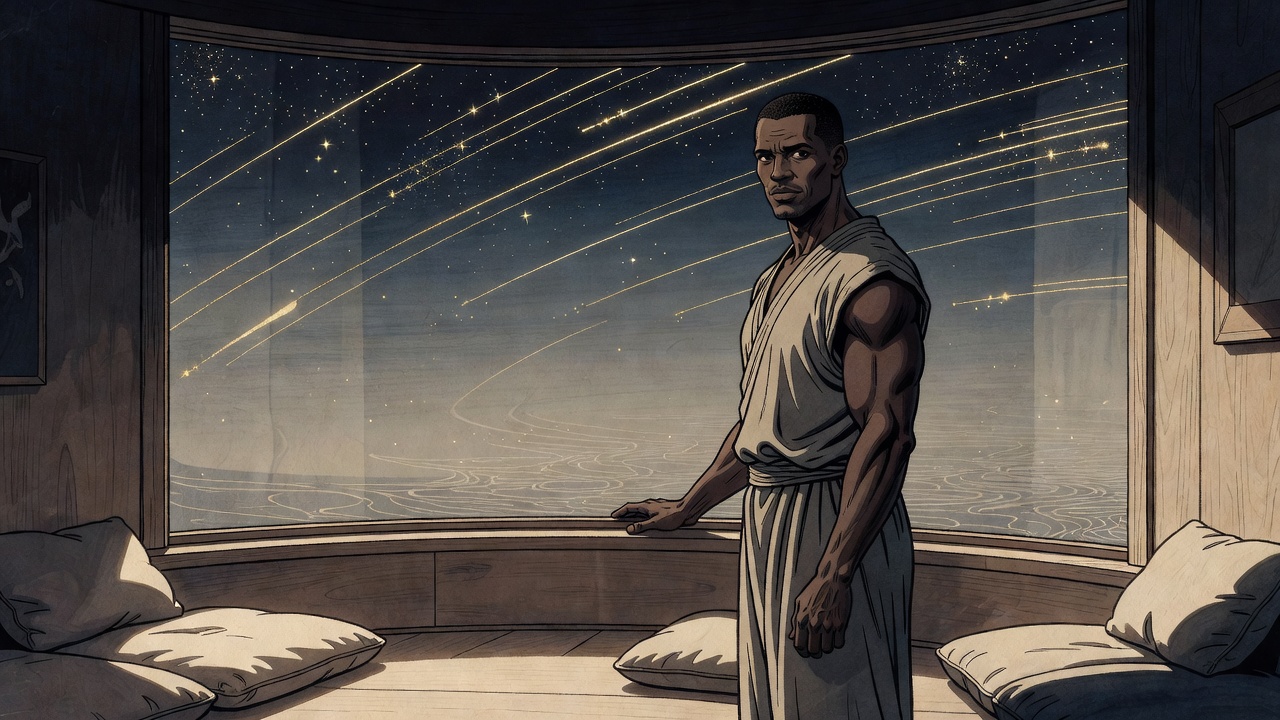
He is in a new body, an Afro-Caribbean combat sleeve issued by Carrera’s Wedge, the mercenary force he fights for. When a wounded pilot tells him about a Martian gate buried on a contested coast, with a Martian starship on its other side, he sees a fortune and a way off the planet. The book follows the scheme from a hospital ship to an irradiated beach and through the gate, in five named parts, each opened by a Quellcrist Falconer epigraph; the short epilogue is folded here into the last.
Where the first book kept the Martians to relics, a songspire in a rich man’s hall, this one puts Kovacs aboard one of their warships. The politics are angrier, too: Morgan acknowledges a debt to John Pilger, and the war here is a business in which bodies, stacks and whole cities are bought and sold. Netflix never adapted it, though its second season borrowed freely from the cast list.
Injured Parties
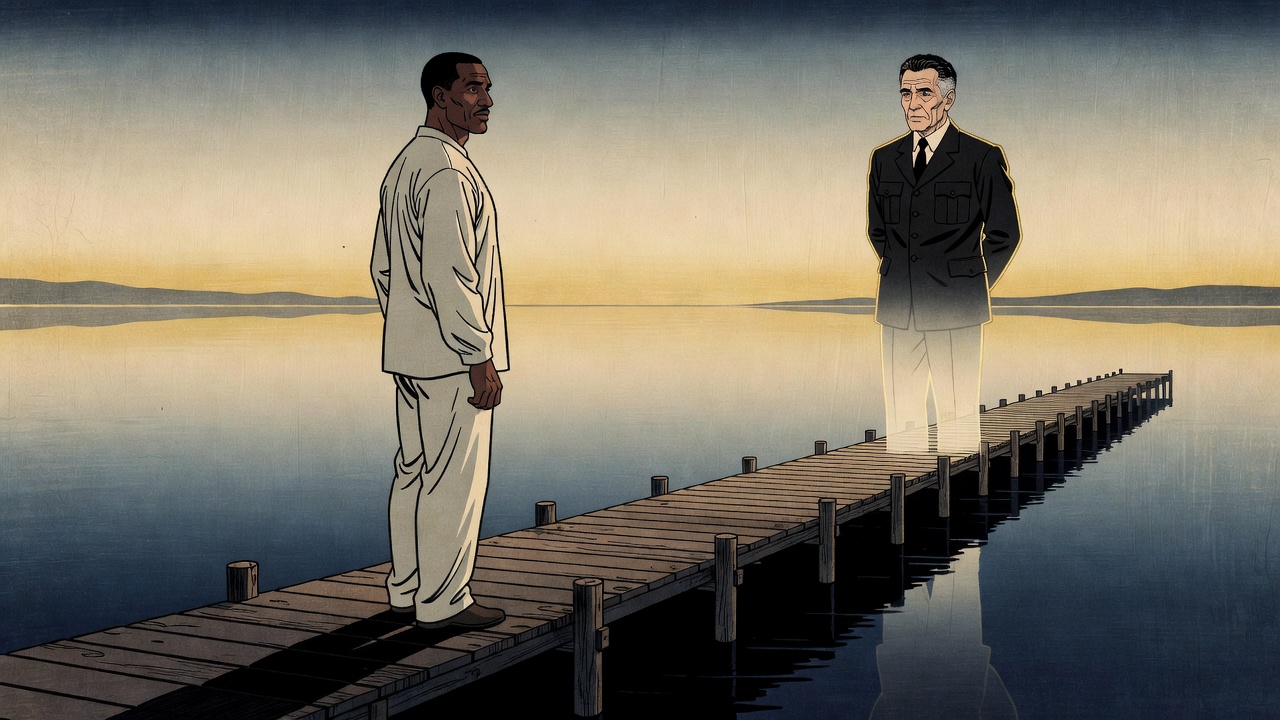
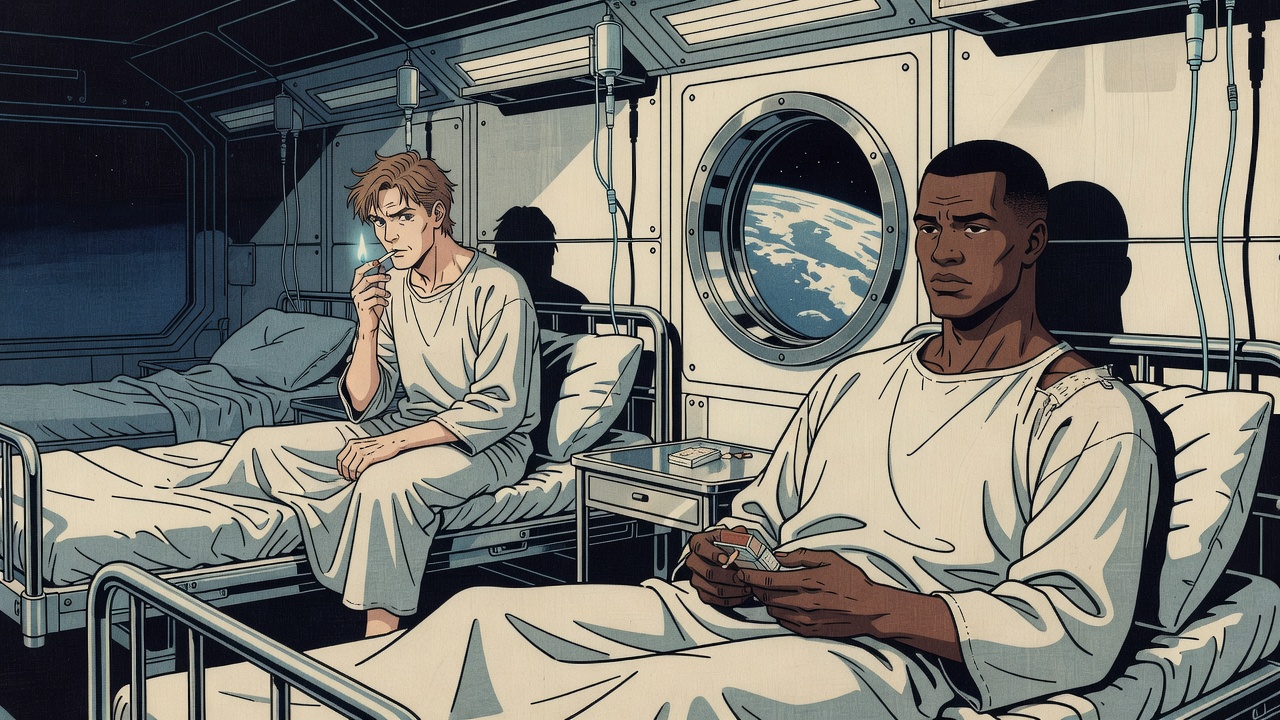
Lieutenant Takeshi Kovacs of Carrera’s Wedge comes off the Northern Rim assault in pieces and is dumped, with what is left of his platoon, on the ice-cold deck of a Protectorate hospital ship in orbit over Sanction IV — a ship that officially is not there, since there is supposed to be no Protectorate presence anywhere in the system. While the medics mend his body, his mind waits in a recuperation construct, a wooden jetty over calm water, where the Wedge’s Afro-Caribbean combat sleeve he wears is whole and unscarred. A recorded briefing from Isaac Carrera, the Wedge’s founder, explains that the sleeve will be repaired rather than replaced, and that Carrera wants him back on the Northern Rim as soon as possible.
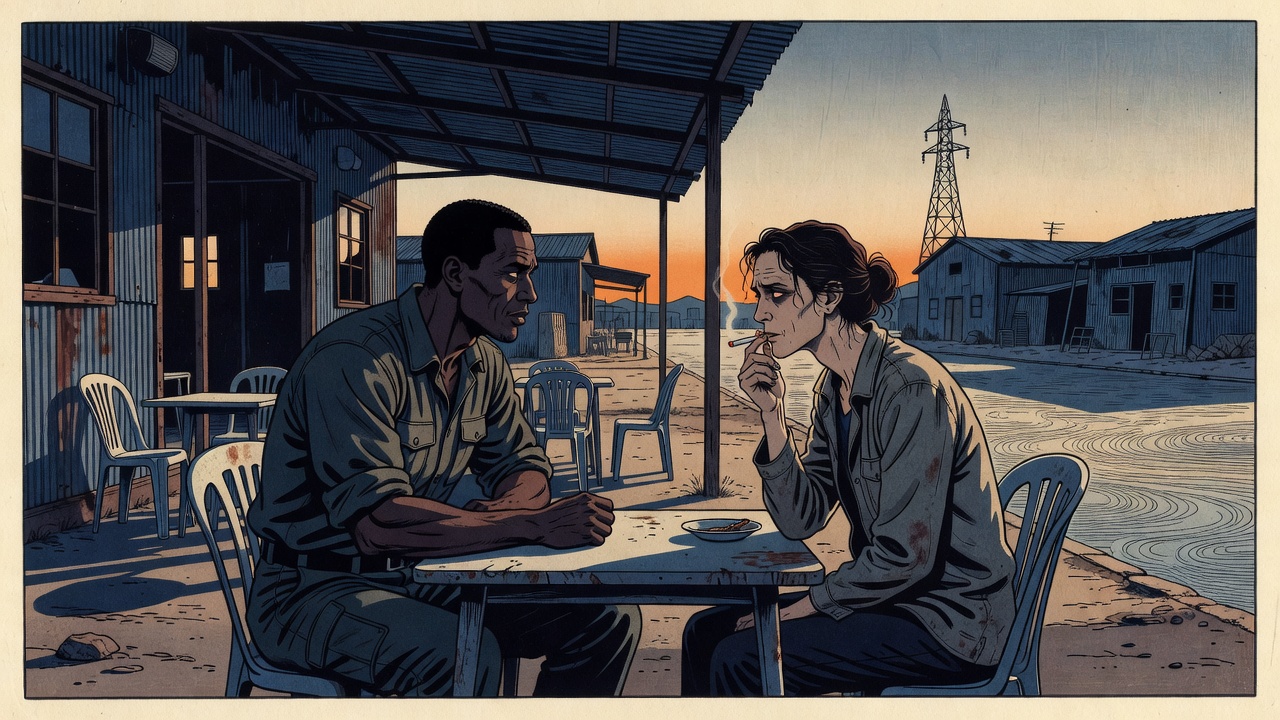
Back in his healed but imperfect flesh, Kovacs visits his wounded: Tony Loemanako, his face still a ruin, Kwok, Munharto. A fellow patient helps himself to Kovacs’s cigarettes and introduces himself. Jan Schneider flew haulage before the war for archaeologues digging on the Dangrek coast, north-west of the city of Sauberville, and the dig, he says, found a Martian gate — and through the gate, a Martian starship. Kovacs, an ex-Envoy who came out of the disaster at Innenin, guesses a hypercaster. Schneider insists it is a gate. The dig’s Guild site regulator was an archaeologue called Tanya Wardani, and Wardani is now in a political internment camp.
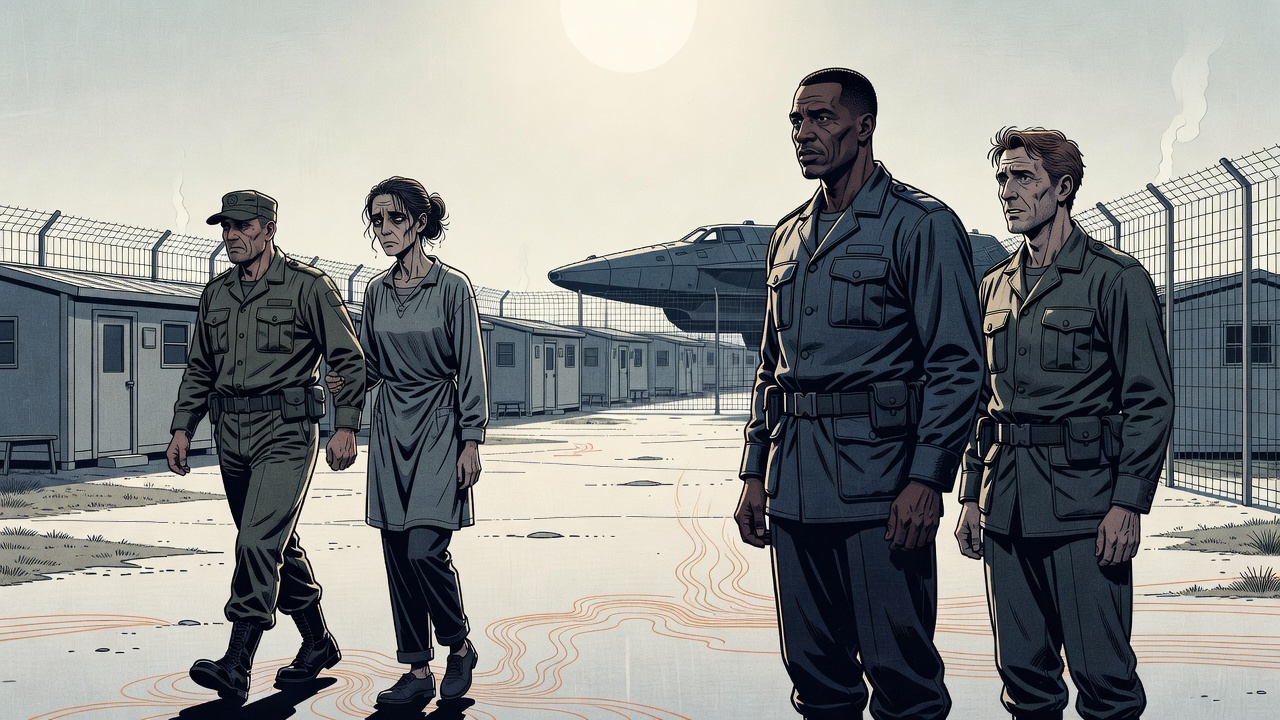
The war is a stalemate between the Cartel government, backed by the corporations of Landfall and mercenaries like the Wedge, and the revolution Joshua Kemp raised in Indigo City. Kovacs puts on his Wedge uniform and bluffs his way into the camp with Schneider: Lieutenant Kovacs of Carrera’s Wedge and Corporal Schneider, come to appropriate Tanya Wardani for interrogation. The camp is heat and squalor. Wardani is brought out long-limbed and starved, with fading bruises under her eyes. She has been abused there.
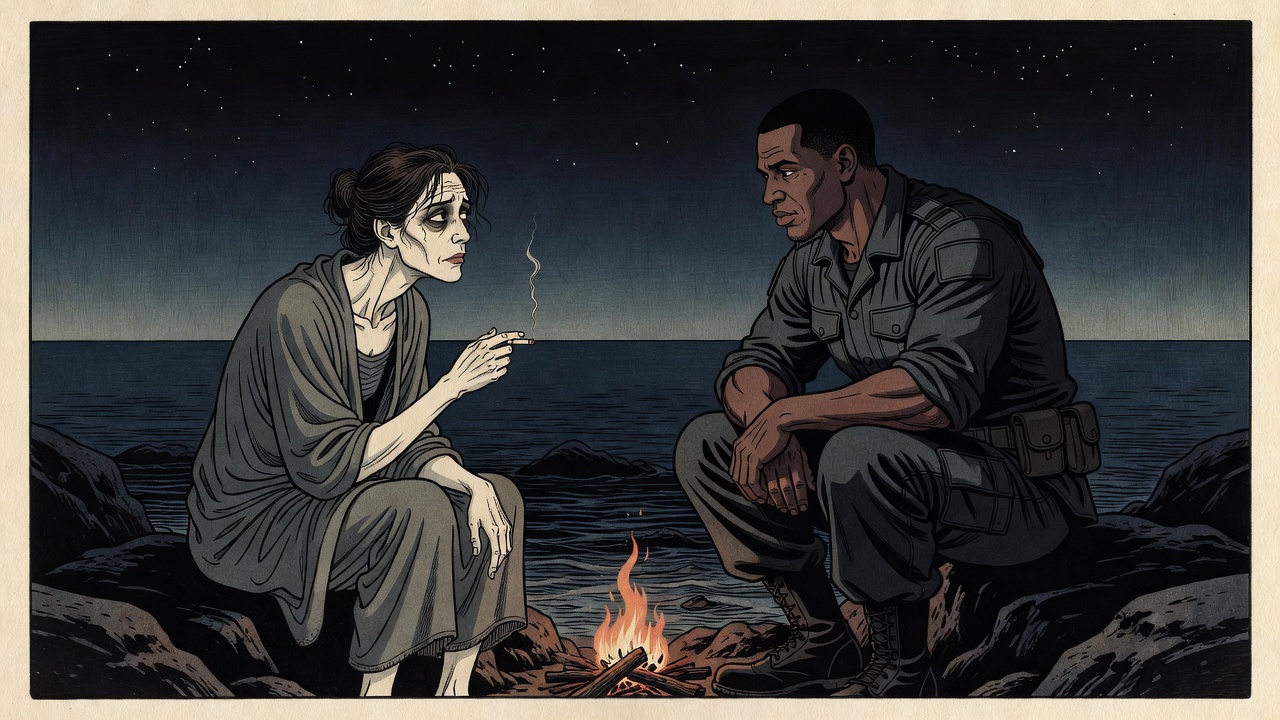
The escape runs low over the sea through Kempist smart mines, Kovacs on the gunner’s mask while Schneider flies, and when pursuit closes Schneider kills the lift and drops them in a steep line back toward the water. Wardani shuts down into war shock. By a fire that night Kovacs talks her back out of it with Envoy technique, trading Innenin for the camp, and she comes back arguing Martian scholarship — hub theory, a reading of the Martian star charts, is to her “a bullshit spin-off”. Kovacs lays out the plan: sell the find not to a giant but to a smaller, hungrier corporation.
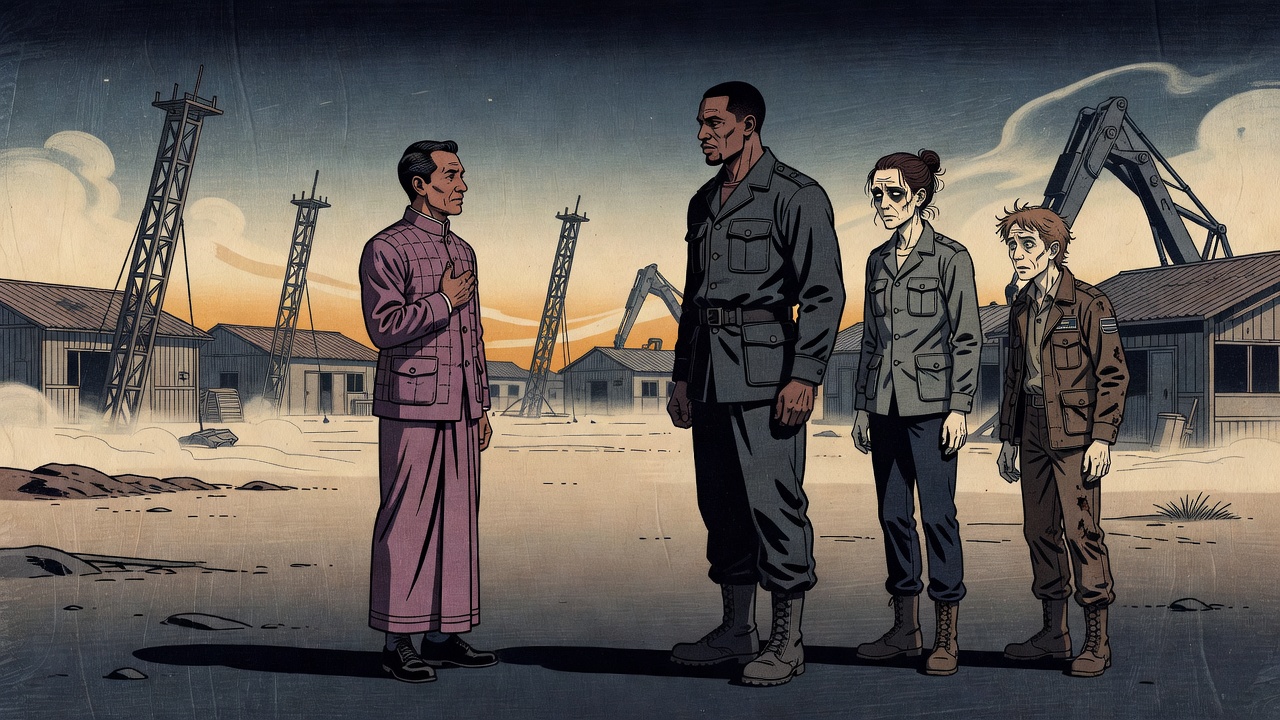
Schneider wipes the shuttle’s datacore and they sell it at Dig 27, a played-out dig town named after its excavation, to Djoko Roespinoedji, a neutral fixer immaculate in a tailored mauve sarong and matching quilted jacket. In Landfall — the capital, a city with no centre, grown out from a spaceport and owned by its corporations — someone tries to kill them. Kovacs kills the attackers first and takes one man’s stack. In a cheap hotel Wardani rigs a scrubber, and in a virtual interrogation the dead man, Deng Zhao Jun, names who sent him: Matthias Hand, of the Mandrake Corporation’s Acquisitions Division. Somebody big already wants what they have. Part One ends with Kovacs ready to deal.
Commercial Considerations
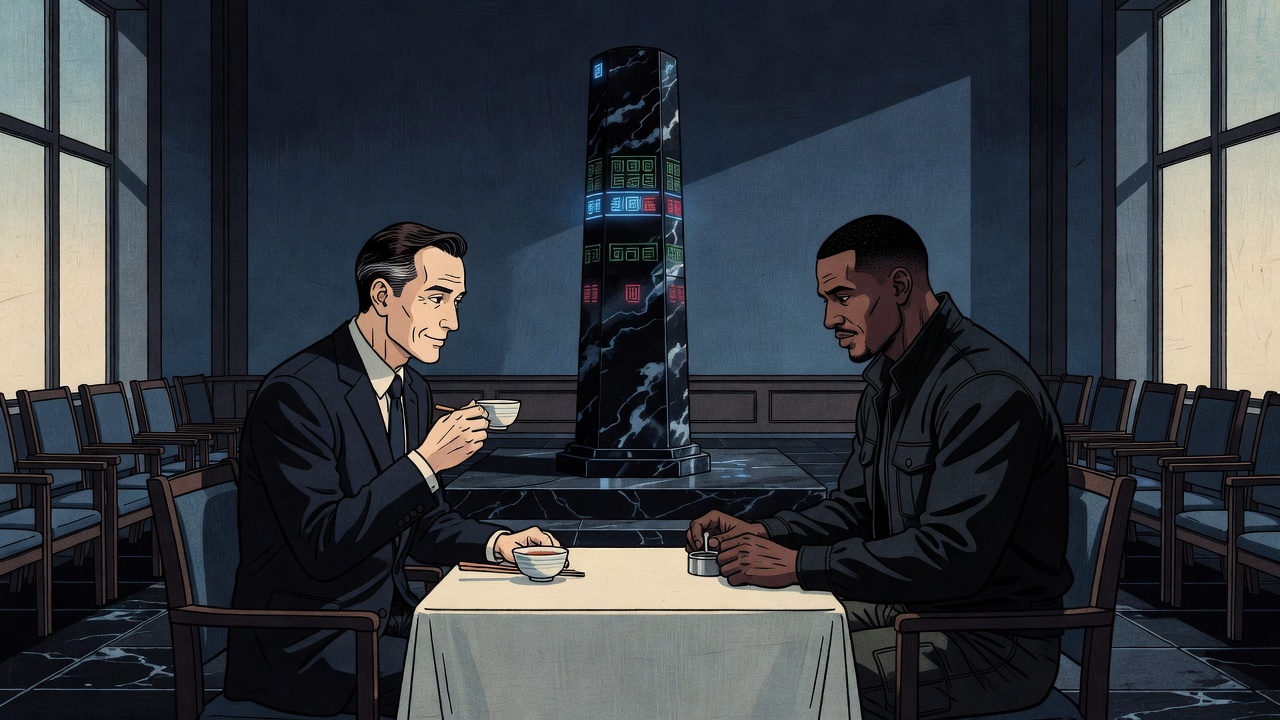
He finds Hand at an artefact auction, a technoglyph pylon from the Lower Danang Field on the block, hands back Deng’s stack and names his terms: a finder’s fee, passage out to the neighbouring Latimer system for his people, and decanting, which earns him a strange look. Hand is polished, impeccably dressed and something of a believer; the dead killer’s gossip says he used to be a hougan, a vodou priest, in the Carrefour Brotherhood, a gang of extortionists on Latimer. Mandrake deals.
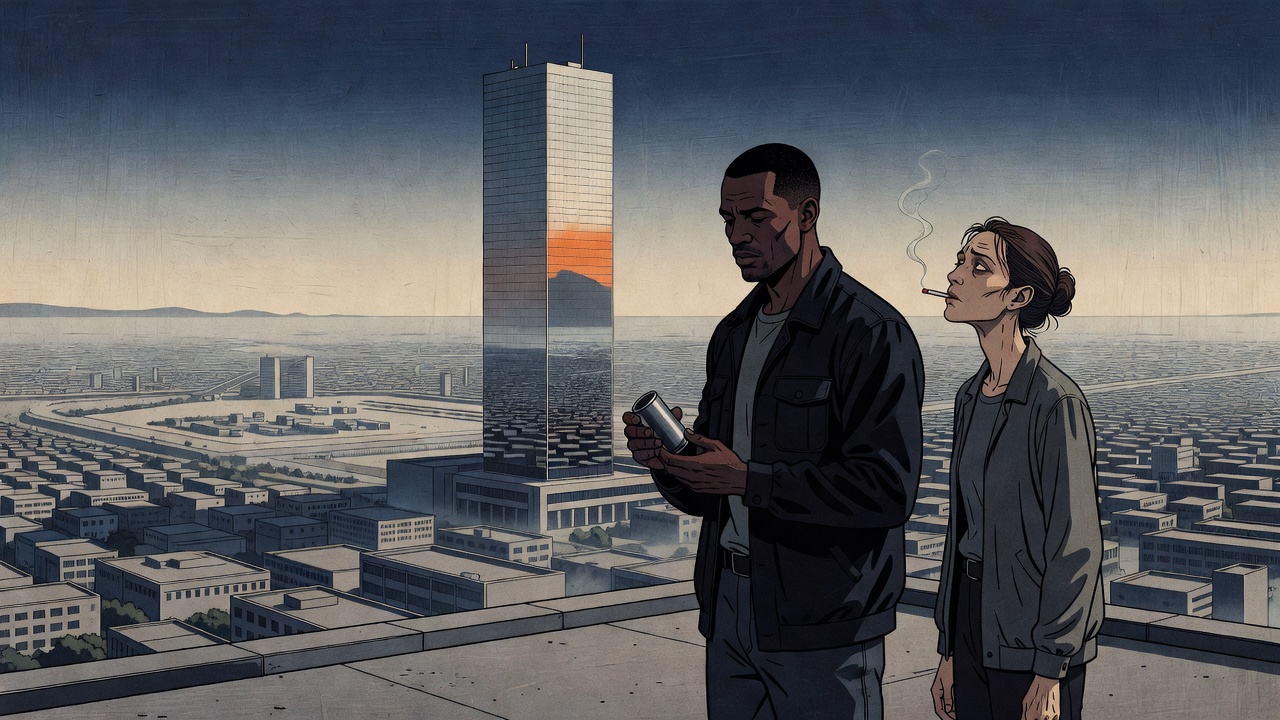
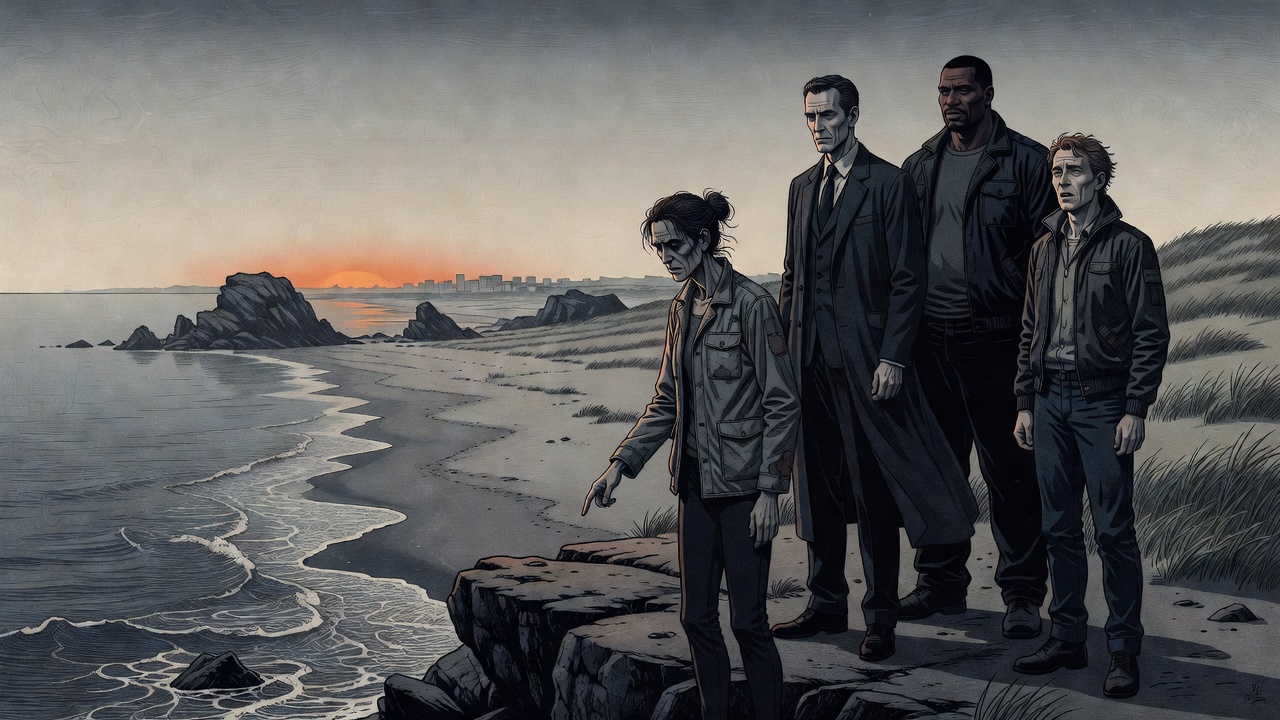
Hand flies out with the three of them to see what he is buying. From a headland on the Dangrek coast, Sauberville is a grey smudge in the distance, and Wardani points out the overhang where the dig team buried the gate under a blast. Then, before Hand can say it, Kovacs feels the answer coming, and Wardani gets there first: “It’s Sauberville,” she says flatly. Hand has the good grace to look embarrassed. Mandrake’s machine intelligence gives even odds that the city, a hundred and twenty thousand people, will be “tactically reduced” within the next two weeks. In a bar afterwards Schneider and Wardani fall out over doing business with the man who sent killers after them, and Kovacs walks Wardani home.
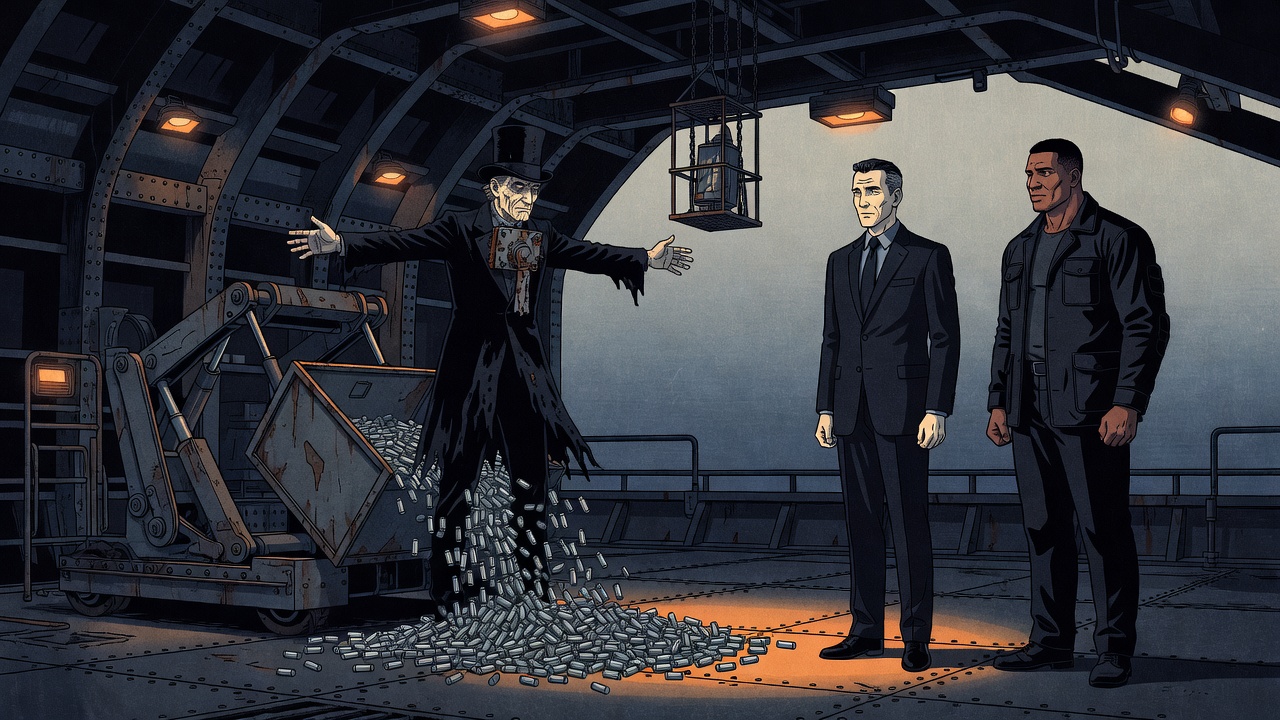
Mandrake has ships and money; soldiers it will buy. Hand takes Kovacs out to Thaisawasdi Field, a graveyard of grounded colony barges, and down into the vault of a refitted barge where a cargo loader upends a skip and buries the floor in cortical stacks freshly cut from the dead. Presiding, arms held cruciform, is a gaunt man in a battered top hat and a long black coat, speaking through a voice unit stapled to his scarred throat.
“I am Semetaire. Welcome to the Soul Market.”
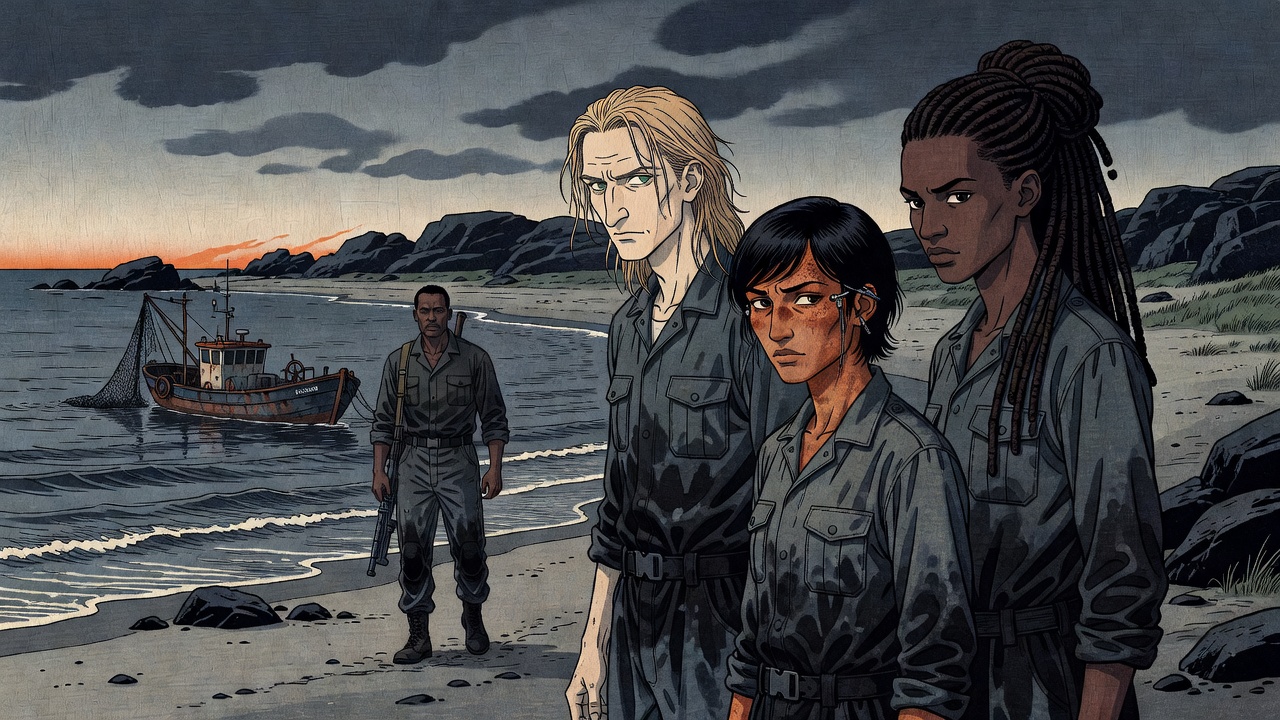
The stacks come mostly from the Suchinda bombardment, civilians and regulars, and most of their owners are too traumatised to use. Mandrake buys them in bulk anyway. Its machines screen them, a psychosurgery dream sequencer tests the rest, and Kovacs interviews the shortlist in a virtual hotel room, where the dead appear in the faces they died in. He chooses seven. Ole Hansen, demolitions, ludicrously pale, his cropped hair white as snow. Yvette Cruickshank, twenty, her dreadlocked mane piled high. Jiang Jianping, a martial artist with intelligent, slightly inward eyes and a light smile. Ameli Vongsavath, a pilot with a hawk face the colour of tarnished copper and silvered sockets for her flight cables. Luc Deprez, a tall, untidy assassin. Sun Liping, systems. And Captain Markus Sutjiadi, beautiful with an uncanny geometric perfection, who is wanted by the Wedge for killing one of its lieutenants, “Dog” Veutin, with his own Sunjet.
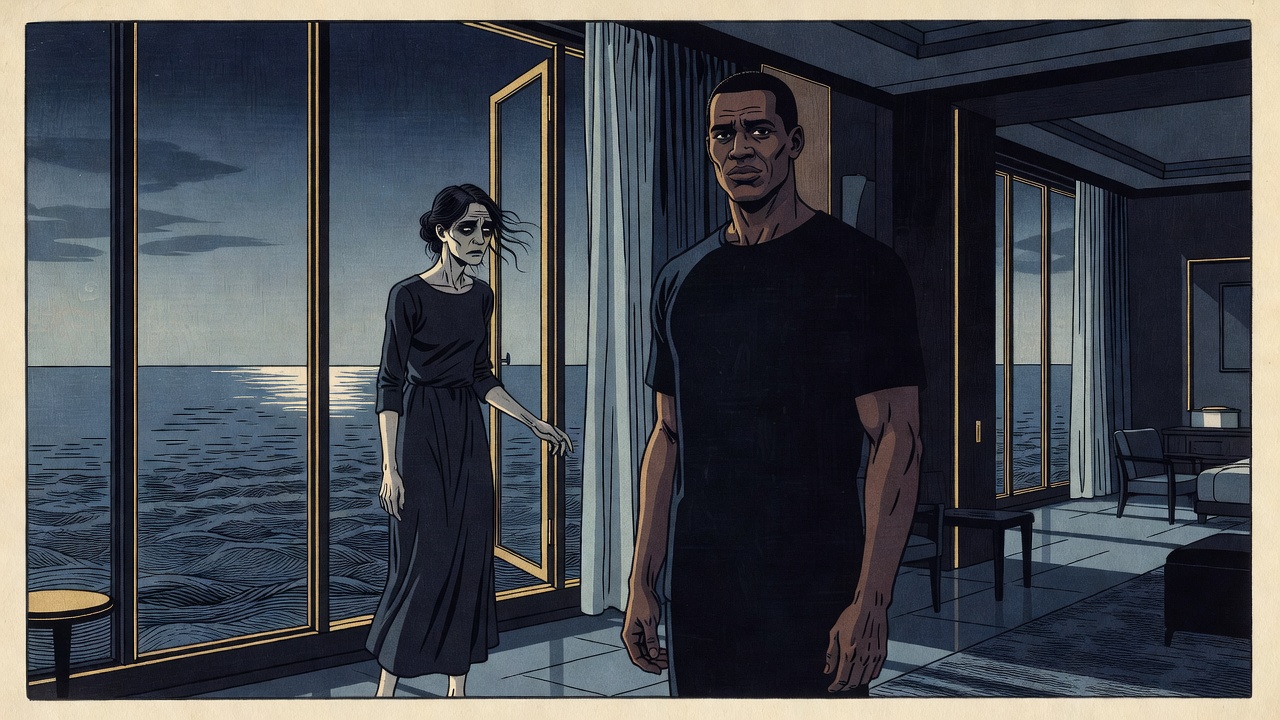
On a sleepless night Wardani asks Kovacs to meet her in a virtual suite on the tower’s recreation level; afterwards he realises he worked his Envoy psychoglue on her without really thinking. The conditioning that makes him persuasive does not switch off. Kempist killers come for him on the rec deck and fail, and Hand begins to suspect a leak in his own company.
The team is decanted into what Kovacs calls “the beautiful rad-resistant Maori combat sleeves”, long-limbed and built for contaminated ground. Then, ten paces ahead of Kovacs and Wardani, Hand stops and turns back with an afterthought: the Kempists airburst a marauder bomb over Sauberville an hour ago. High yield, hundred per cent casualties. Wardani stares at the middle distance, mouth clamped, while Hand watches it happen. He, it will emerge, leaked the intelligence that provoked Kemp’s forces into the strike: a city traded to clear the coast for Mandrake’s expedition.
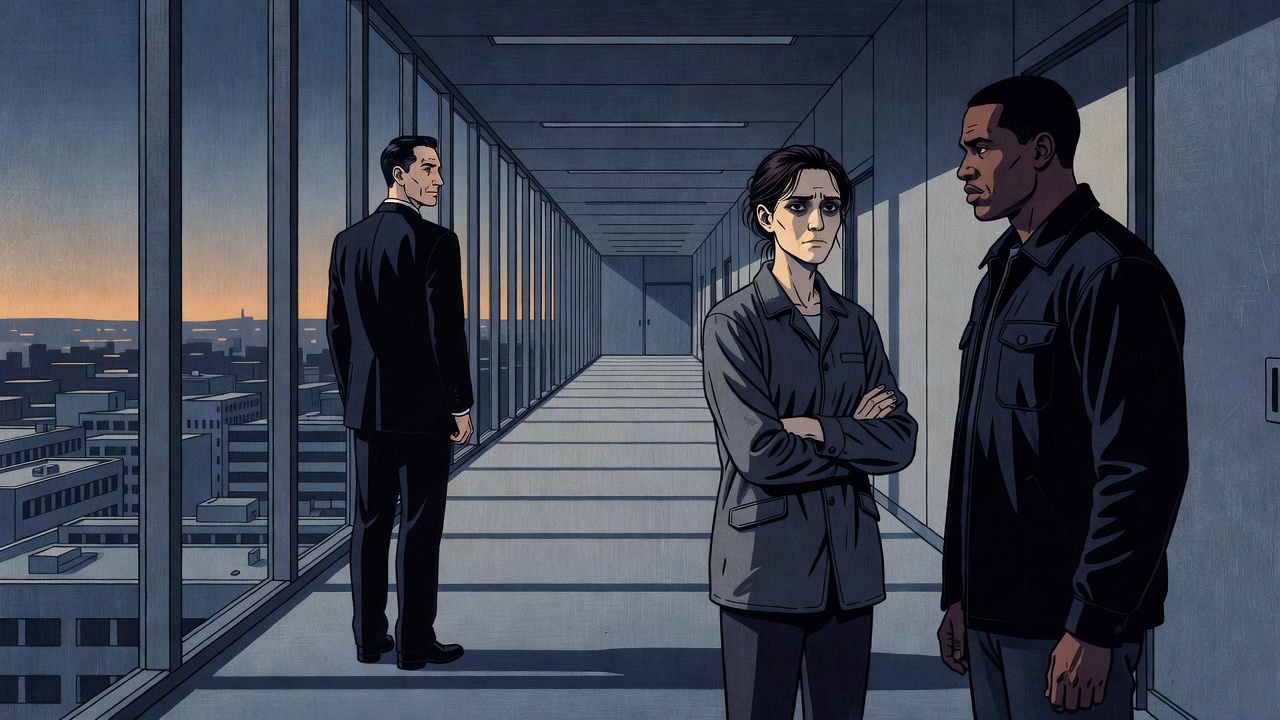
Disruptive Elements
“There is no subtle way to deploy an IP vessel across half a planet”
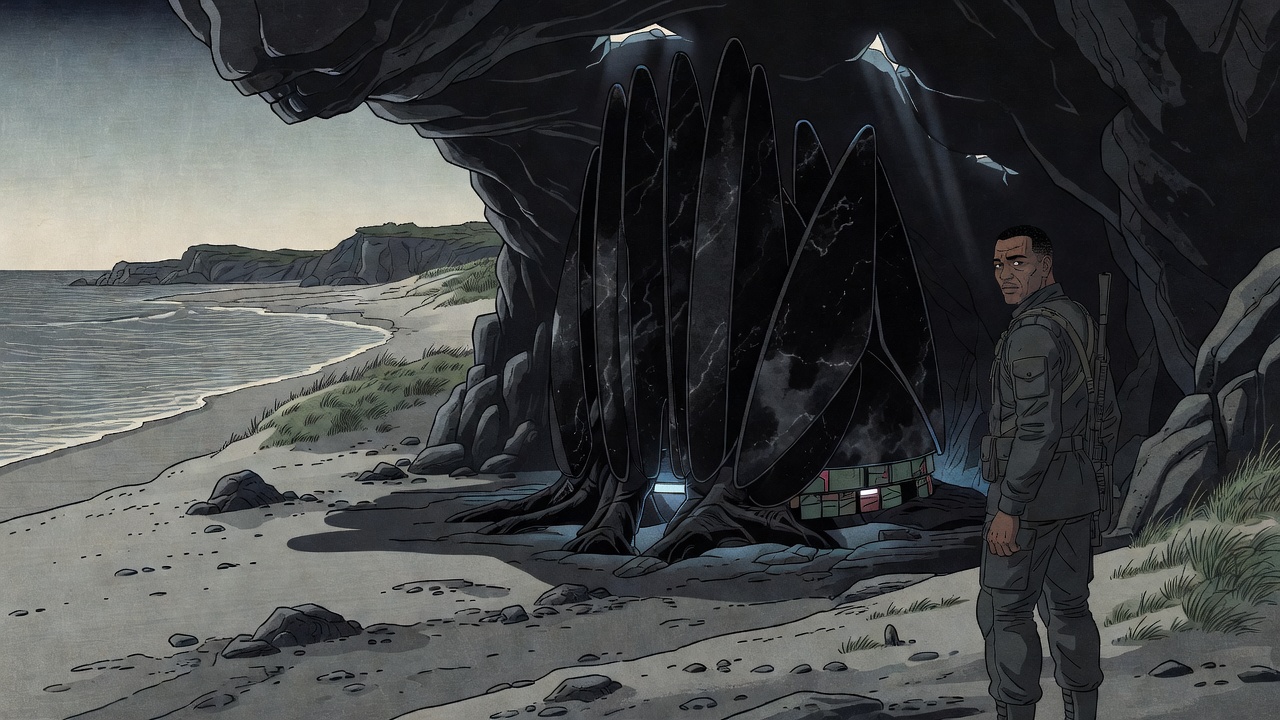
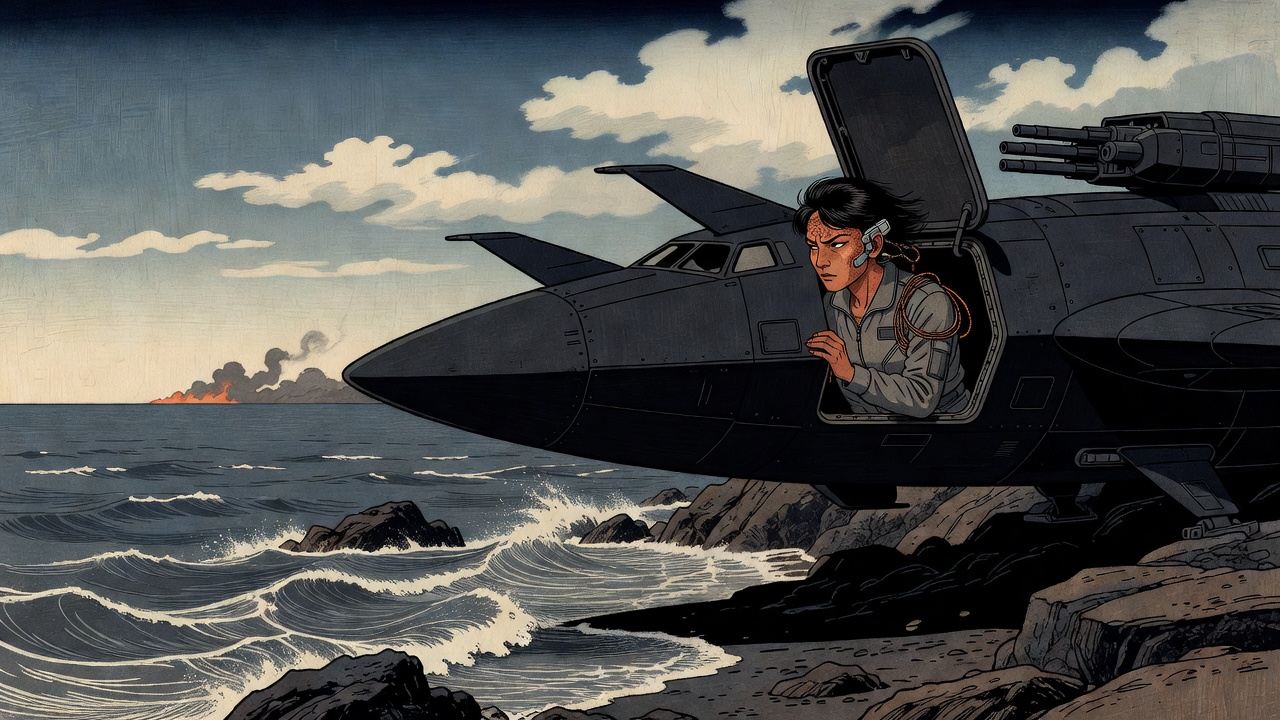
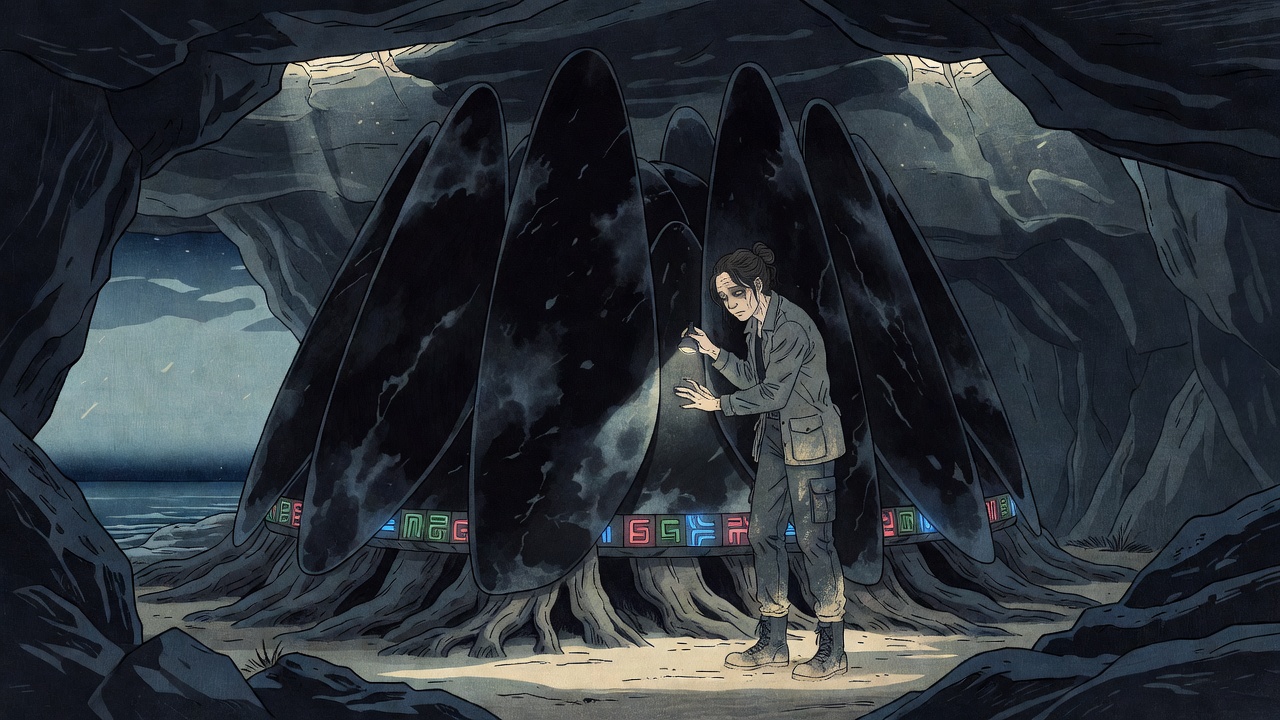
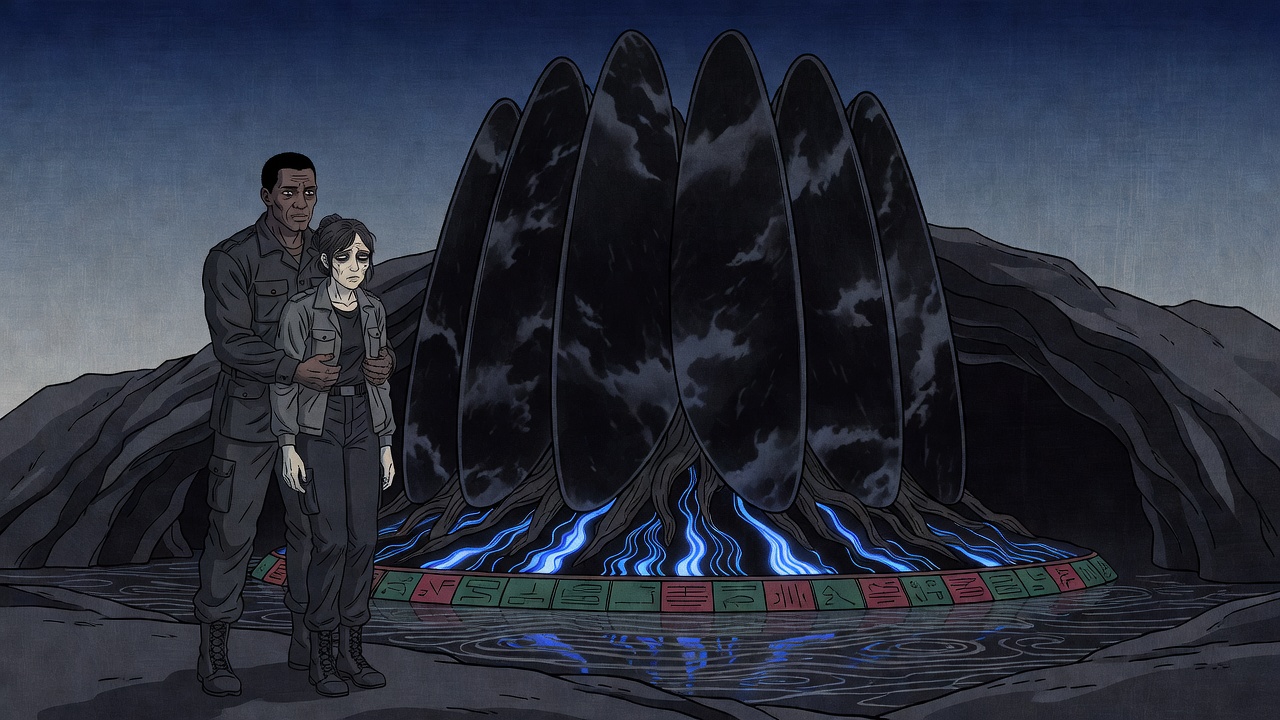
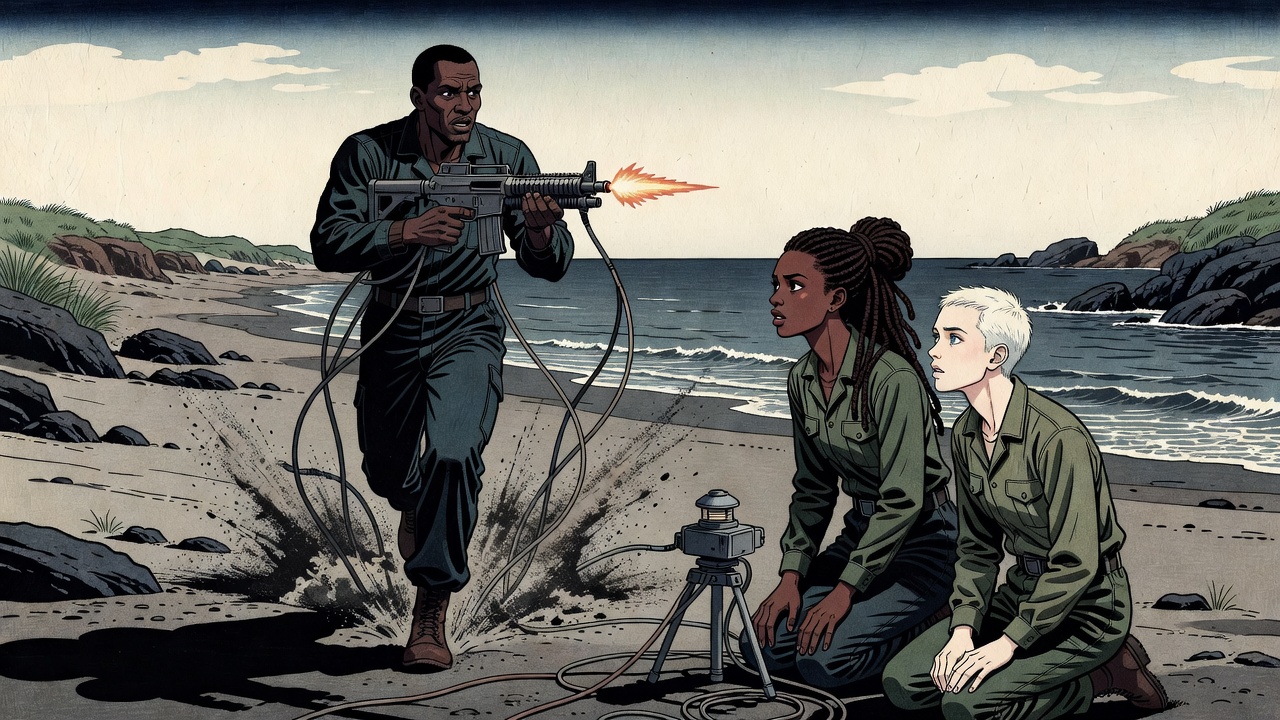
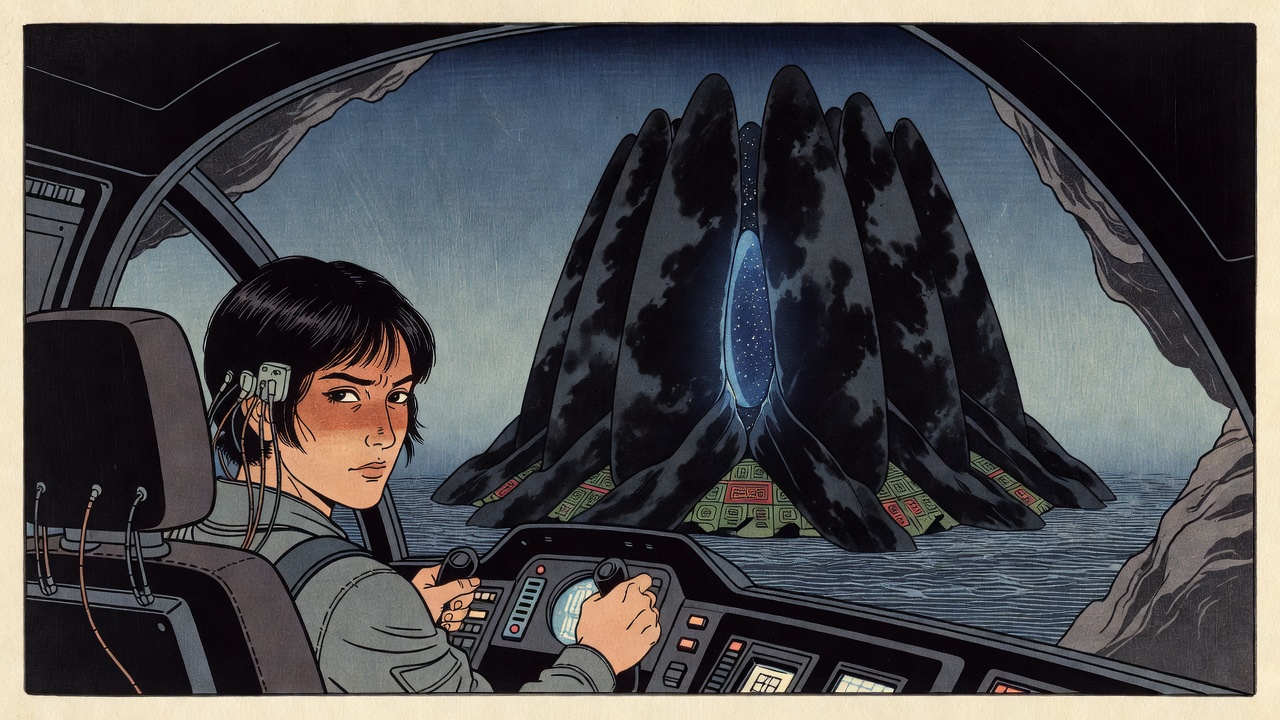
Mandrake does it anyway. The fast assault launch Nagini, flown by Vongsavath, drops out from under the corporate air umbrella and splashes down off the Dangrek coast, while a needlecast message from Carrera warns them off. The beach is empty, and down the coast Sauberville is still burning, its smoke crawling up into an “old denim sky”. An abandoned trawler rides offshore; Deprez, Vongsavath and Cruickshank go out to it, and there are two corpses in its net. The gate, uncovered, is nothing like the word: a black mass of Martian alloy like six or seven ten-metre bats crushed back to back, its base grown into the rock like roots, its glyph panels dull green and ruby, its surface always faintly charged. Sutjiadi wants to clear the rock with the Nagini’s ultravibe battery; Hand and Wardani refuse. Wardani begins the technoglyph sequencing that should open it, and works herself to exhaustion.
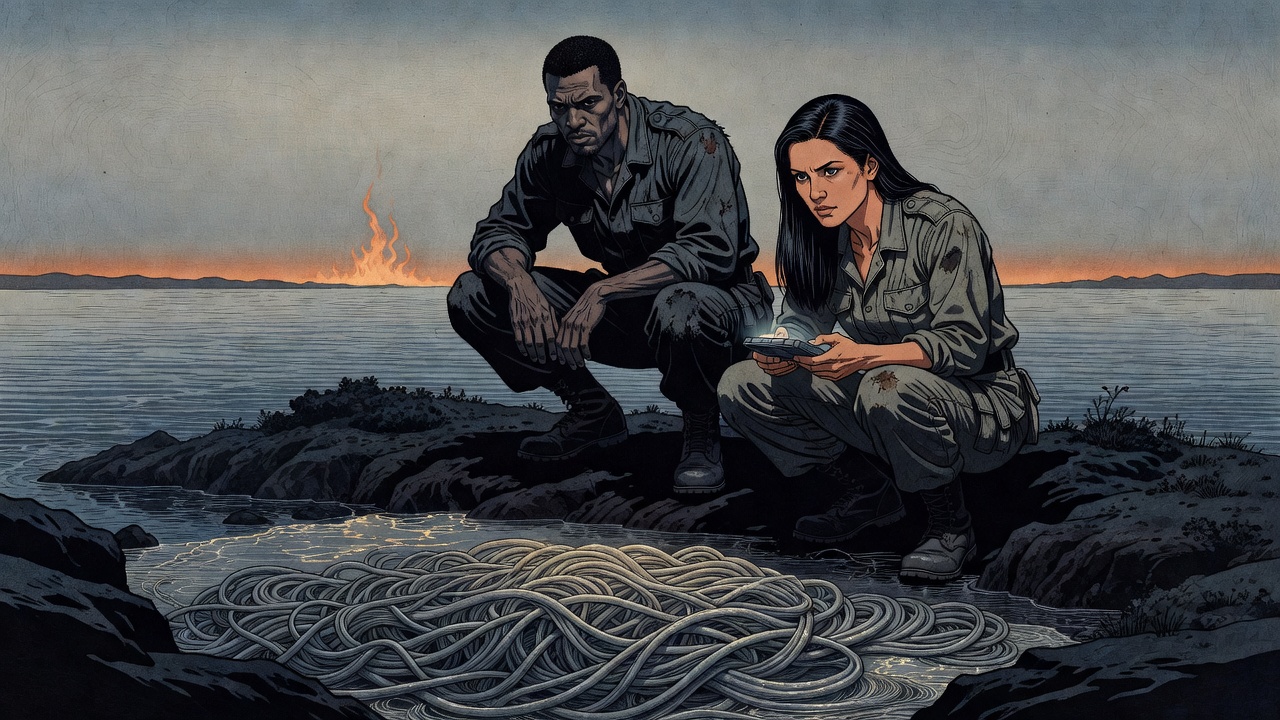
Inland, Kovacs and Sun find a writhing grey mass: a nanobe colony. Hand admits what it is — smart, short-lived nanobe systems in a null configuration, which evolve tougher and smarter each time they are attacked — and that a rival inside Mandrake seeded them to kill the expedition if he fails. Worse is invisible. The fallout from murdered Sauberville is in all of them; the team’s new clones fail a little more each day, and the sleeve the Wedge so carefully repaired for Kovacs is dying of radiation sickness. Two days into the nanobe hunt he is vomiting.
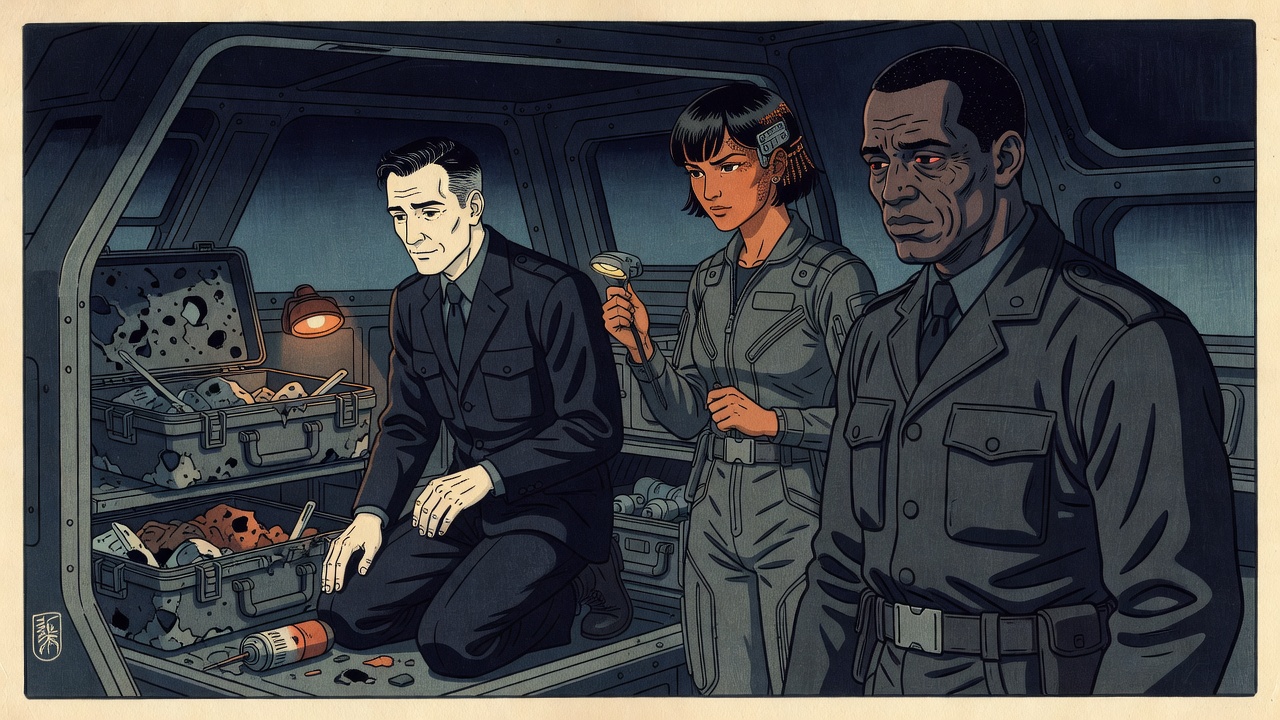
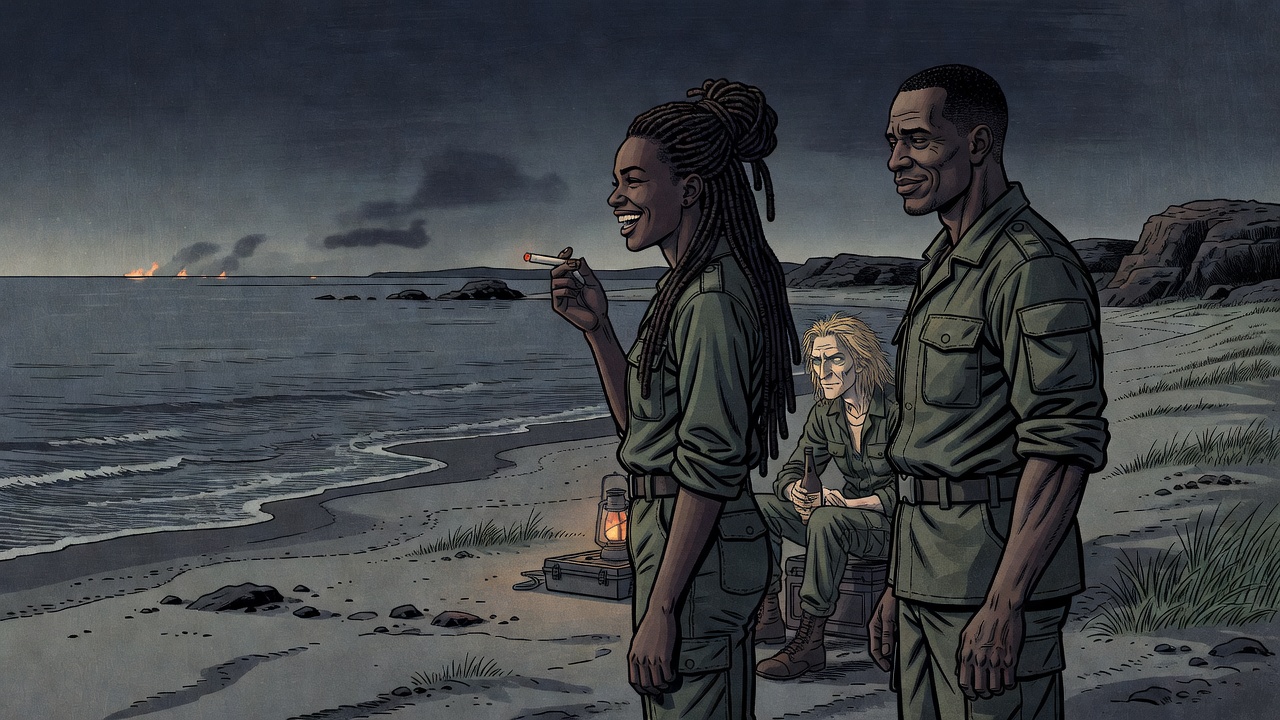
Then someone sets corrosion grenades in the Nagini’s hold, and the leak eats into the equipment there, the Mandrake claim buoys among it. There is a saboteur on the beach. Kovacs, Hand and Vongsavath decide what to tell the rest, and Kovacs thinks he has the logic sorted: Schneider has the flyer skills to shut down the launch’s onboard monitors; Wardani probably does not. They shell the nanobe colonies at dusk; Kovacs and Deprez share whisky; there is a party on the sand with banned Indigo City cigars, and Kovacs spends the night with Cruickshank.
Wardani finishes the sequence and collapses, saying the gate is open, and a light show begins to climb the structure: a countdown, of hours. A Mandrake claim stands only if a working claim buoy sits within a kilometre of the find, and the find that matters is on the far side, so Cruickshank and Hansen spend the best part of an hour prepping a buoy. The nanobes, evolved past the weapons that held them, come up out of the ground, and they kill Cruickshank and Hansen.
Unexplained Phenomena
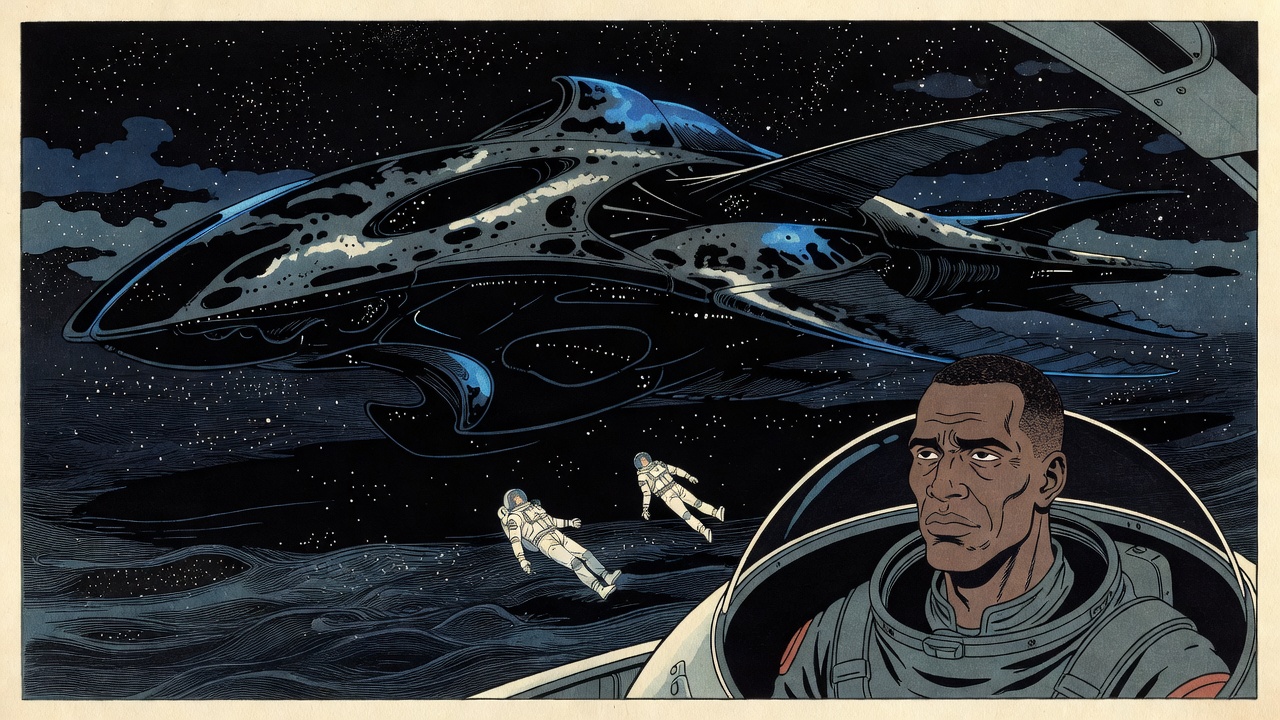
In the last nanobe attack the gate opens, and its opening shuts the nanobes down. Vongsavath takes the Nagini through into deep space. At the gate they recover the blackened, ruptured remains of Tomas Dhasanapongsakul, one of Wardani’s first team. On the other side hangs a colossal derelict Martian warship, and around it drift more of that team in vacuum suits, the glyph specialist Pharintorn Aribowo and three men, one of them a suicide. They are bagged in the launch’s lock, Dhasanapongsakul first, and the pouches lie beside those holding Cruickshank and Hansen. The puzzle sharpens inside: the ship holds breathable air, so why did they die in their suits?
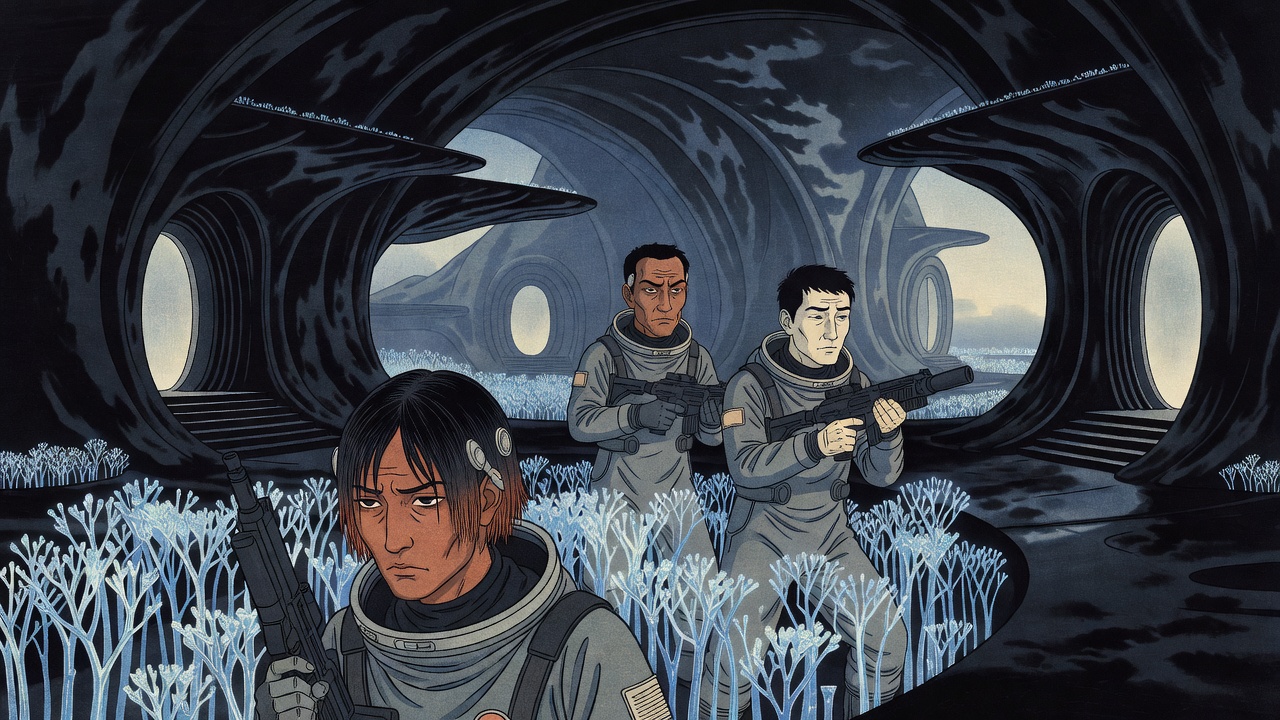
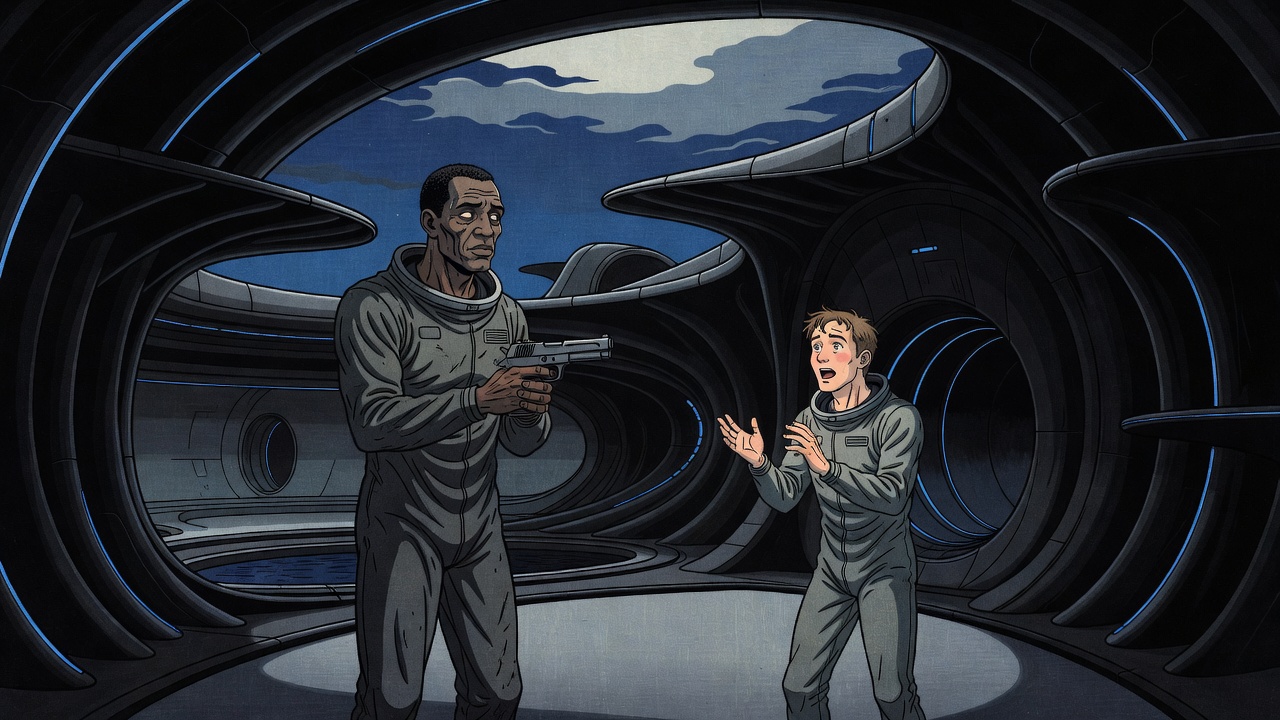
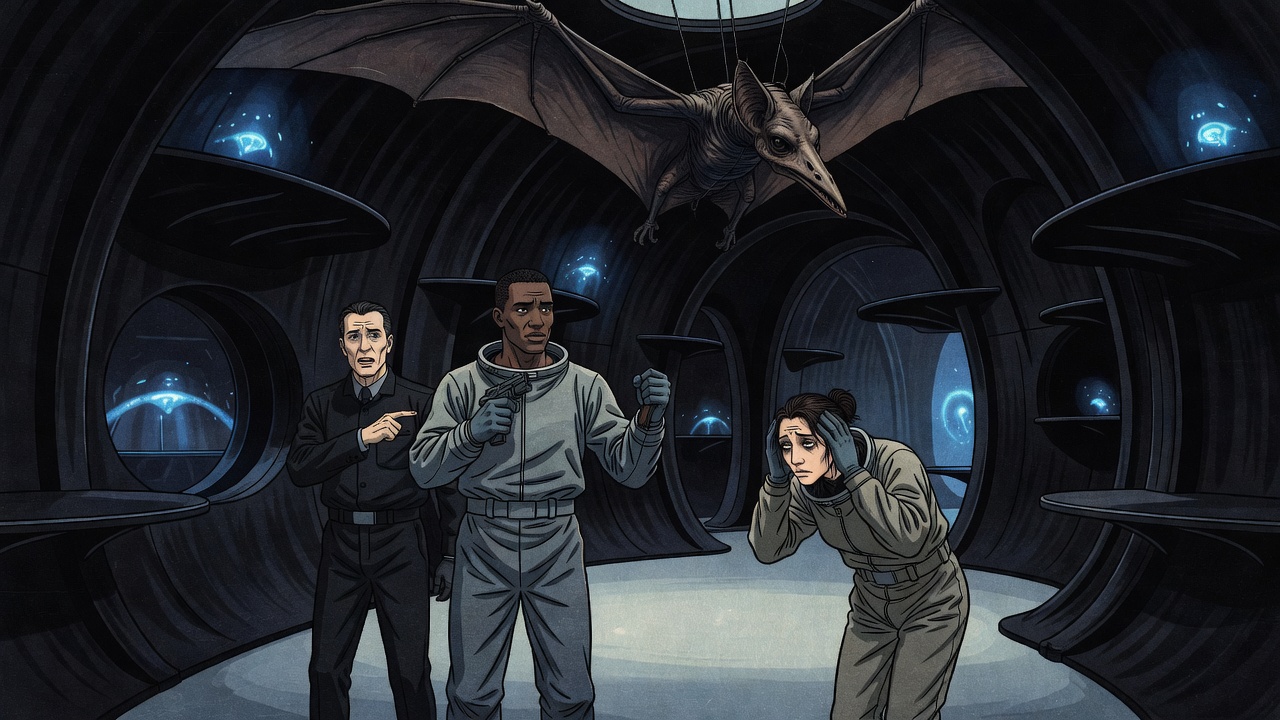
The team goes in through chambers built for bodies that were never human, past a whole bonsai forest of songspires sprouting across the floor and up the curve of a corridor, singing and sobbing, to a platform open to the stars, where Martian corpses hang in webbing under a pearly light. Intact Martian corpses are that rare: a couple of hundred in four centuries of archaeology on three dozen worlds.
Kovacs looks at Schneider in that breathable air and sees what is wrong: everyone else is dying of radiation, and Schneider is not. Confronted, Schneider runs for the gate in the Nagini, and Jiang is killed in the escape. Kovacs had his suspicions, and had mined the launch to blow on re-entry through the gate. It does.
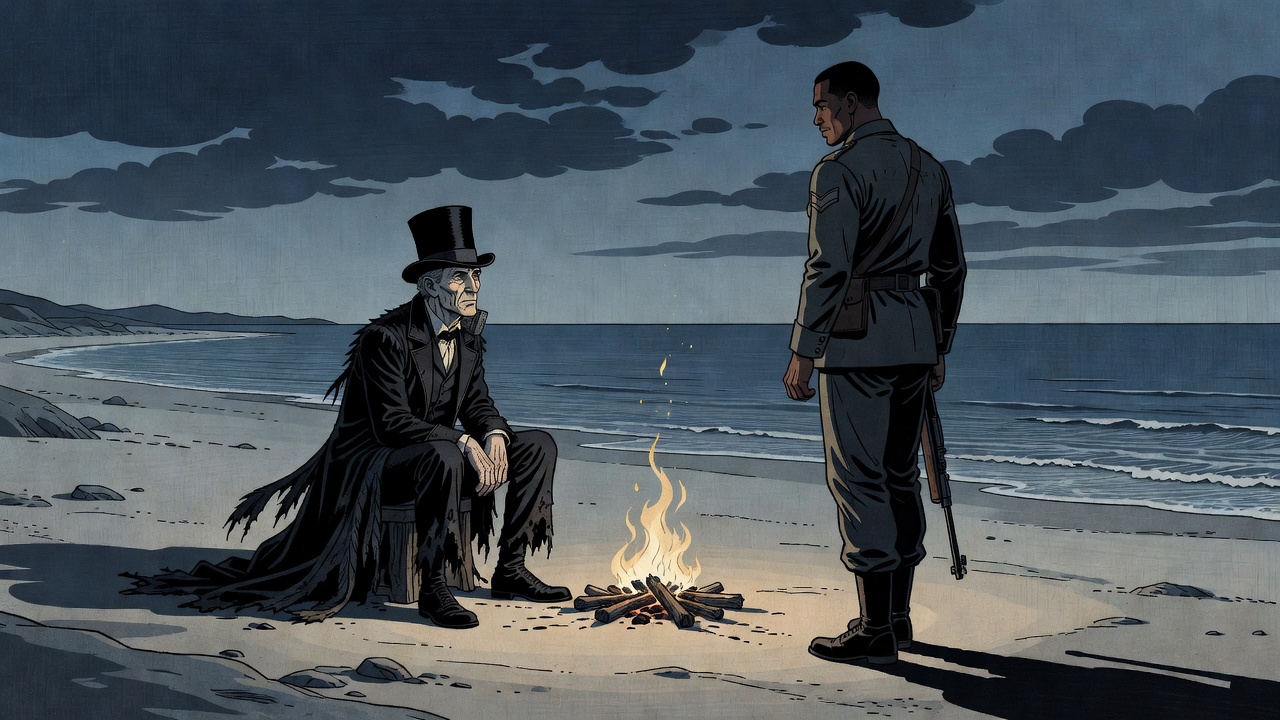
Then the ship’s datasystem wakes. An unknown ship attacks, and the Martian warship’s defences fight back; through the battle the grief of the ship’s dead floods into the humans’ minds until they are close to madness. It is Hand, the corporate believer, who understands what is happening and orders Kovacs to stun them all. Kovacs does. In the dark that follows he dreams a beach and a fire, and finds Semetaire waiting by it. The Soul Market’s dealer has been a voice in his head ever since the barge, insisting he is no charlatan and that “Semetaire is only one of a hundred names”. Kovacs tells him to get out of his head. Semetaire reaches across the fire for him, and the Kalashnikov is in Kovacs’s hand.
Divided Loyalties
“Face the facts. Then act on them.”
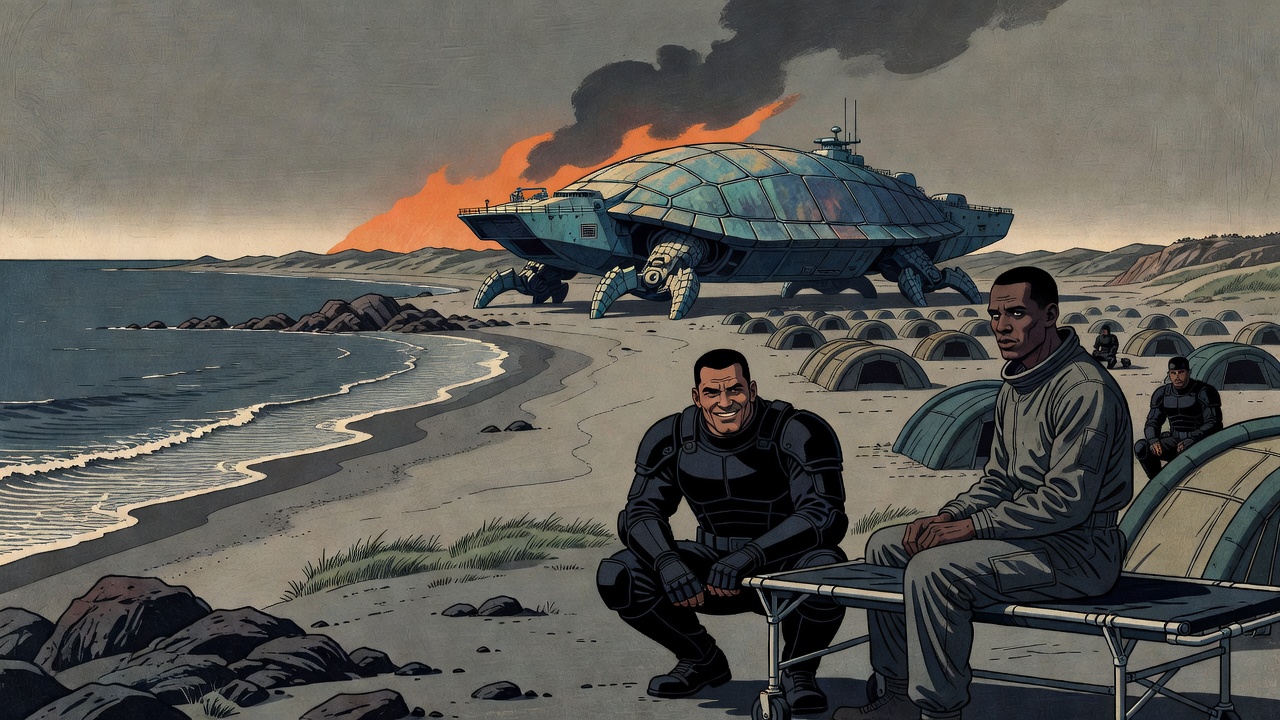
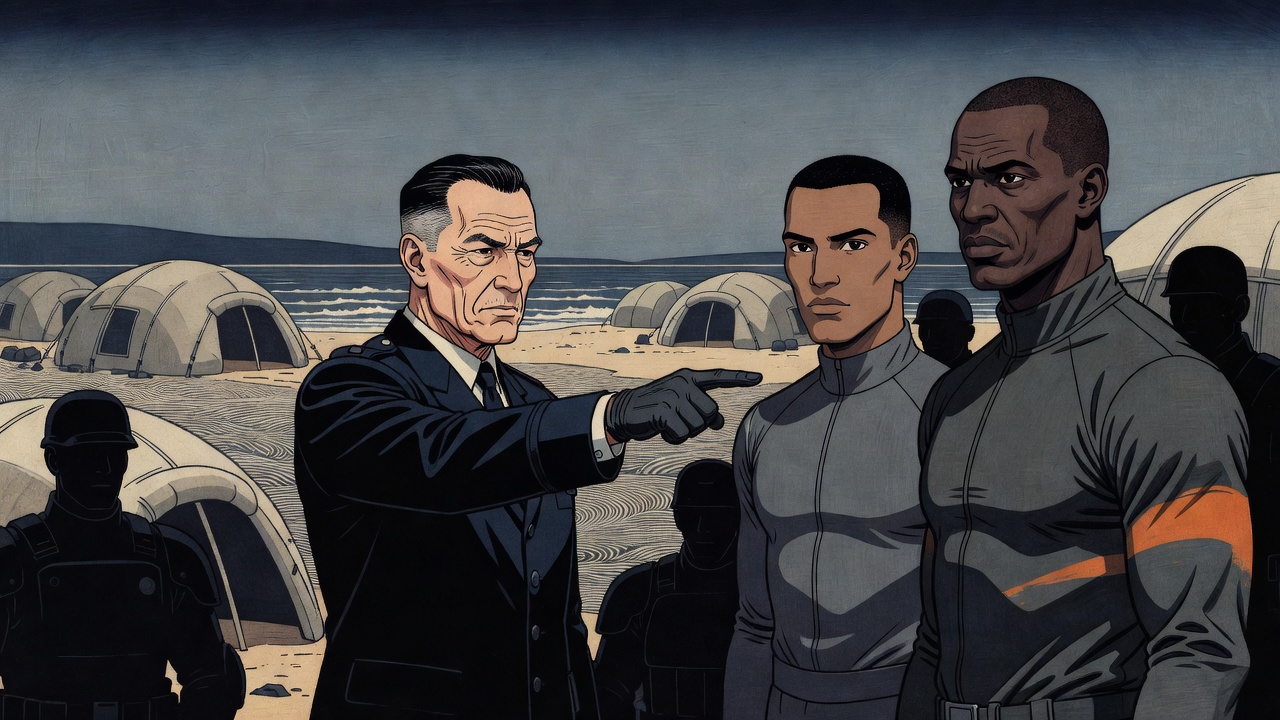
Kovacs wakes in a suit on the Sanction IV side. The Wedge has come through the gate after the battle and brought them back, and the beach is a Wedge camp now: bubblefabs, commandos in black polalloy, the battlewagon Angin Chandra’s Virtue squatting on its assault landing claws, its chameleochrome hull turquoise against the beach, and a crater where the Nagini blew. Tony Loemanako welcomes his lieutenant to base camp.
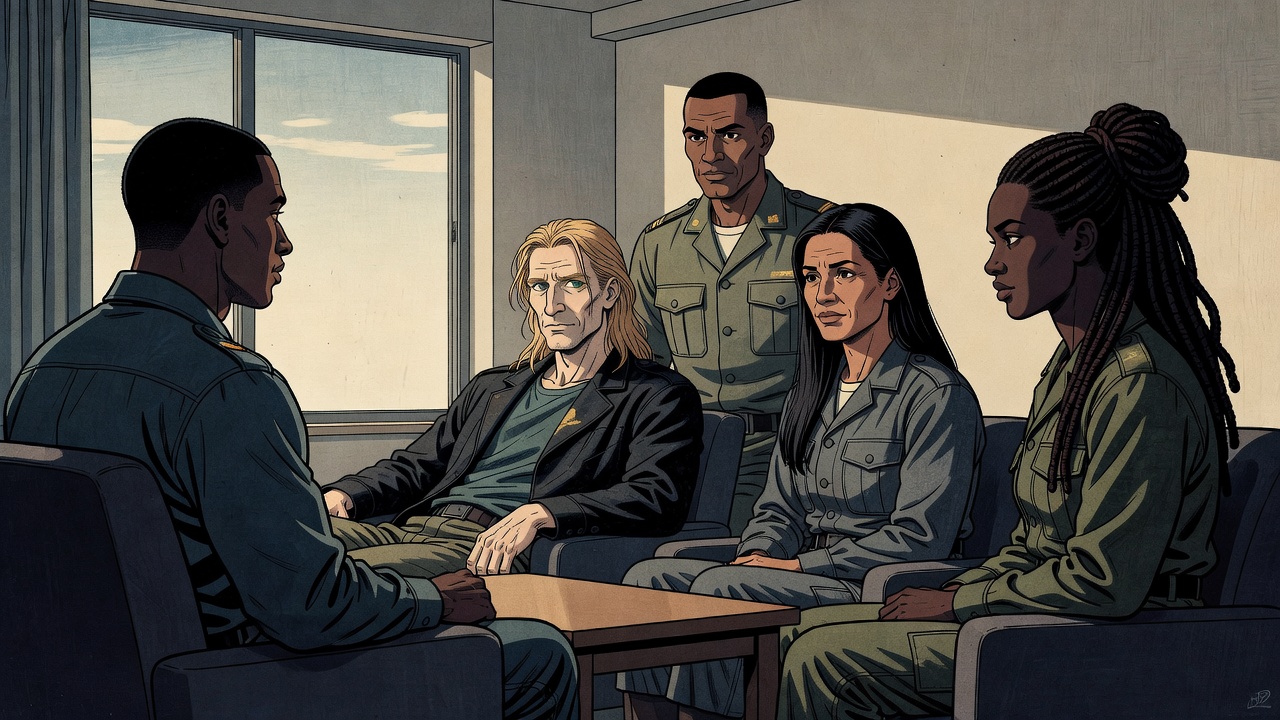
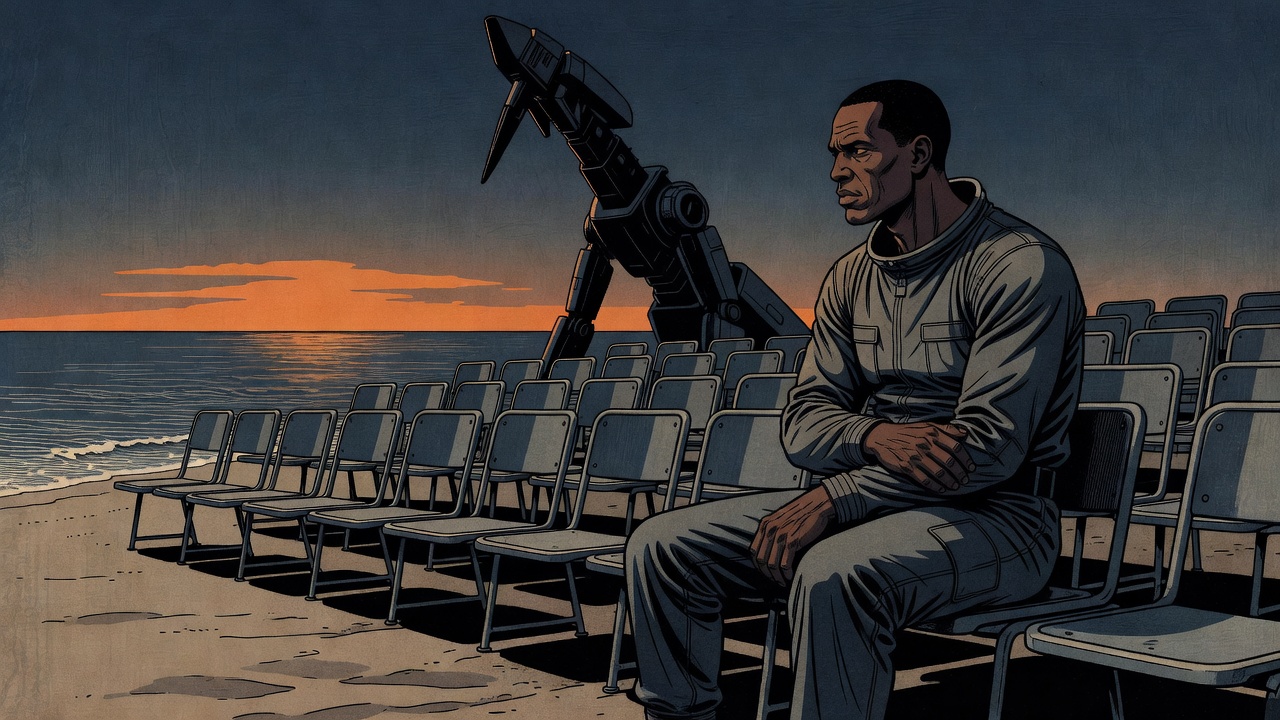
Carrera debriefs the survivors. Then, in a voice pitched to carry, he names the man calling himself Jiang Jianping: his real name is Markus Sutjiadi, and he is wanted for crimes against Wedge personnel. Loemanako loses his grin and supplies the rest: Lieutenant Veutin and his platoon sergeant. Kovacs had swapped the names on the casualty list, and it was not enough. Sutjiadi goes to the anatomizer, the Wedge’s execution machine, set up on the beach with seats banked round it like an arena, and screams through a day of it.
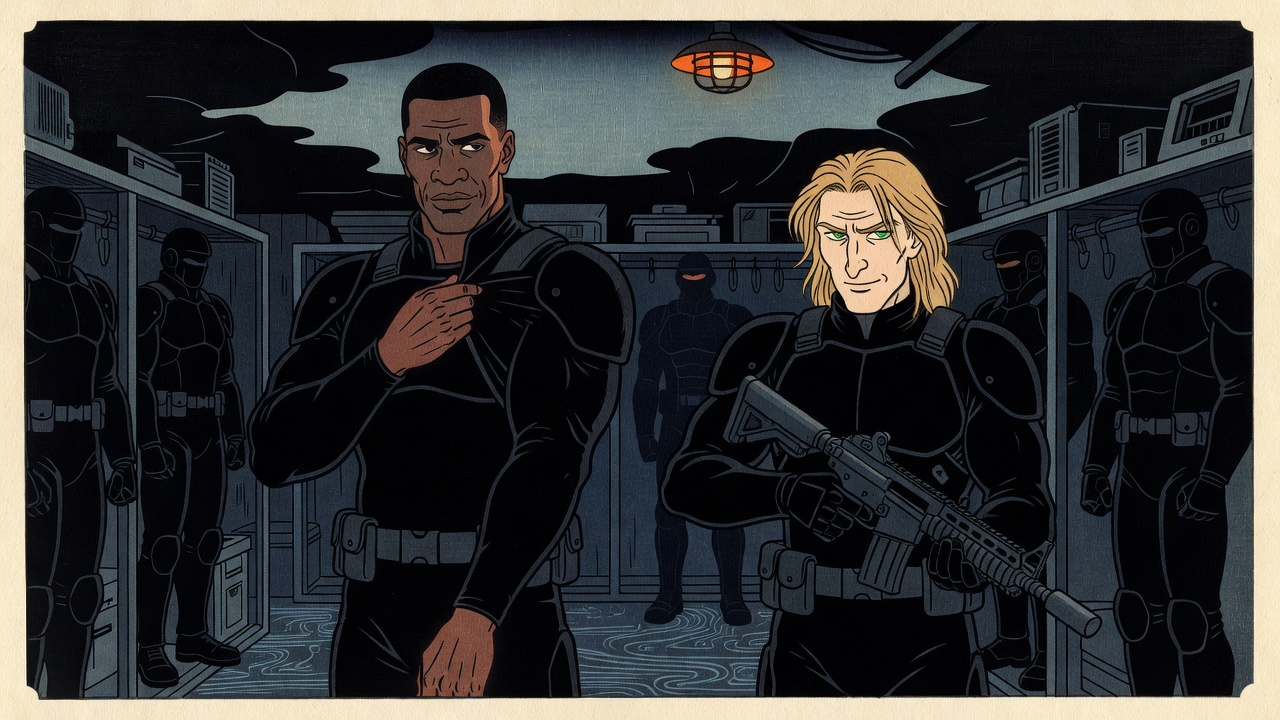
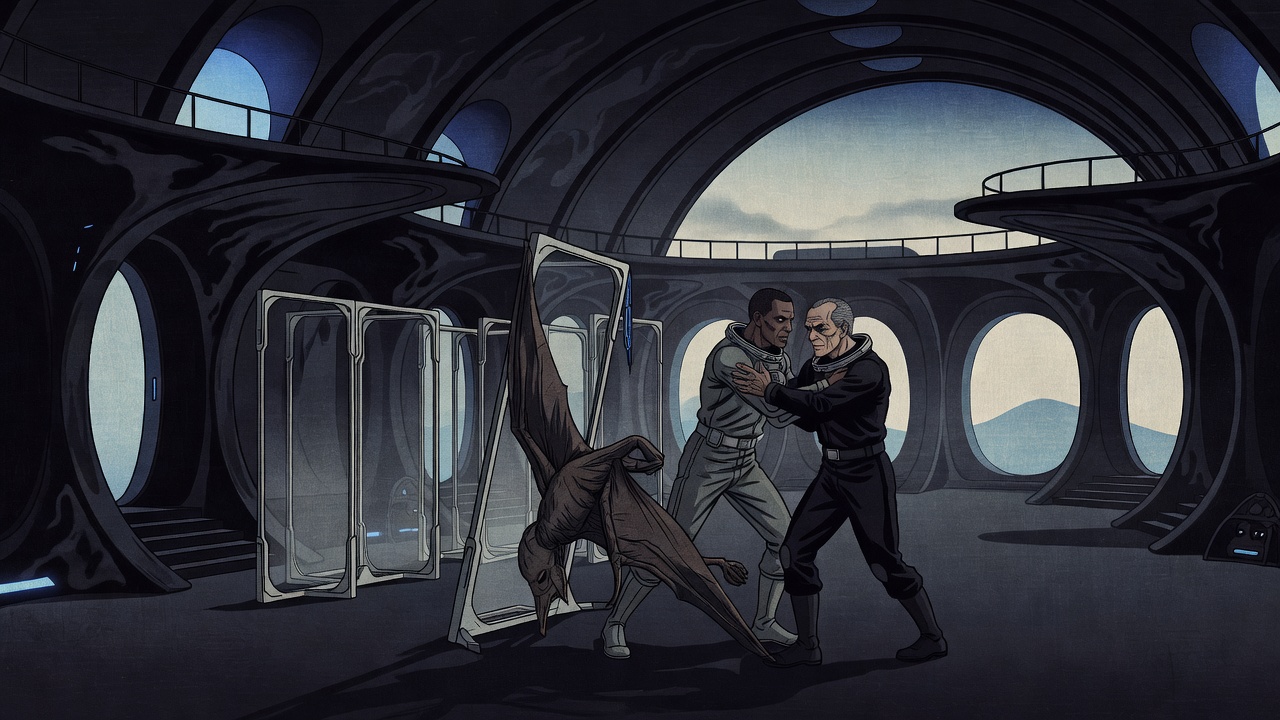
Kovacs tears a regrowth biofilament out of his own arm to short the inhibitor that holds him, and breaks out. With Deprez, both in the Wedge’s own black polalloy, he takes the Wedge unit apart; Deprez is wounded and dies while Kovacs is away. Running on tetrameth, close to dead from radiation, Kovacs shoots Lamont, the unit’s political officer, and Wardani stops speaking to him. Carrera escapes through the gate. Kovacs follows him to the Martian ship and kills him in its docking bay, the two of them smashing into the frame of a mummified Martian corpse until it tips and collapses.
Back at Dig 27, where Djoko Roespinoedji has to be talked round once more, the last secret comes out, and it is Wardani’s. When her first team meant to use the ship as a weapon, she closed the gate on them and left them to die in space; the two corpses in the trawler’s net were hers. So were the corrosion grenades in the Nagini’s hold — Schneider, her lover and an old flame of hers, shut down the launch’s monitors for her — and their real target was not the buoys but the interrogation sets, so that no one could question Dhasanapongsakul and the others. So, too, were the killers on the rec deck: she led Kovacs there. She will stay on Sanction IV to see the gate recovered. Kovacs trades the rights to the ship for the survivors’ passage out.
The epilogue is in the present tense, aboard the battlewagon, the ‘Chandra, which only Vongsavath can fly. The survivors are living out the eleven-year transit to Latimer in a virtual, “at about a hundred times the speed it’s really passing”; they will be back in the Latimer system by the end of the month. Kovacs admits at last why he came to Sanction IV. He came for the Quellists, to twist Kemp closer to their designs; he sided with Kemp, then the Wedge, then Mandrake, and the Quellists will want a report on why he changed sides. Meanwhile he listens for some echo of what he found aboard the ship that now bears the name Tanya Wardani.
What the screen took from this book
- Netflix never adapted Broken Angels. Laeta Kalogridis, the show’s creator, said in 2018 that the second book, with its planet-wide war, nuclear strikes, alien dreadnought and interstellar battle, was “prohibitively expensive in scope”, and told IndieWire it was “a little expensive”. Season 2 (2020) is a loose adaptation of Woken Furies instead, set on Harlan’s World — but it borrows a run of names and ideas from this book. What follows is what it took; very little of it means on screen what it means here.
- Carrera and the Wedge — the name and the unit, not the man. Season 2’s Colonel Ivan Carrera leads “the Wedge”, an elite Protectorate (CTAC) unit made entirely of upgraded sleeves; he is really Jaeger, Kovacs’s old CTAC commander from season 1’s flashbacks, in a new sleeve and under a new name, and he tortures Kovacs in episode 3. The book’s Isaac Carrera is a mercenary, an ex-Vacuum Command captain who founded the Wedge, and Kovacs’s employer, never his Envoy handler. Both die at Kovacs’s hands; the screen Carrera is first consumed by the alien mind the show invents. Kovacs’s own season 2 body is a Wedge combat sleeve, too.
- Joshua Kemp moves planets and changes sides. On screen he is the Quellist leader on Harlan’s World, secretly Danica Harlan’s collaborator, whom she has shot by a Captain Veutin (episode 6). In the book Kemp leads Sanction IV’s revolution and is never a Quellist; Kovacs was there to push him toward the Quellists, and failed.
- Veutin: a name reused. The book’s “Dog” Veutin is the Wedge lieutenant Sutjiadi killed; the show’s Captain Veutin is Danica’s officer.
- Semetaire and the Soul Market. In episode 2 Kovacs visits the Soul Market, a Millsport club where stacks are worthless and memories are what sell, and Semetaire guards its door; he dies confronting the possessed Carrera in the finale. The book’s Soul Market is a stack bazaar in the vault of a grounded colony barge at Landfall, and its Semetaire a dealer in a vodou guise who follows Kovacs into his dreams.
- Mandrake survives as the Mandrake Mines, where Trepp hunts a Quellist recruiter in episode 3.
- The Martians become “Elders”. The show gives the aliens a new name, an Elder skeleton and a winged Elder in virtual, and invents a surviving Elder hidden in the Songspire roots that possesses Quell, then Carrera, then Kovacs, and a genocide of its kind by Harlan’s Founders. None of that is in the books. What is borrowed is the sense of the Martians as a physical, winged species whose dead still have power over the living: in this book, their mummified corpses and the grief of the warship’s dead that nearly drives the team mad. The orbital platforms and their angelfire belong to Harlan’s World, glimpsed in the first book and central to Woken Furies, though the word “angelfire” turns up in this book too.
- The title. Season 2’s finale, episode 8, is called “Broken Angels” — the only season 2 title not taken from a classic film — but its story is the Angelfire and Harlan-family climax, not this book.
- Not borrowed: the gate, the Martian warship, Sanction IV and its war, Sauberville, the nanobes, Wardani, Schneider, Hand and the seven recruits from the Soul Market. The book’s Envoy material (Innenin, Virginia Vidaura’s voice) was not adapted that we found, and nothing from it was found in the anime film Resleeved.
Continuity notes
- Kovacs wears one body all book: the Wedge’s Afro-Caribbean Khumalo combat sleeve, repaired rather than replaced after the Northern Rim, then poisoned by Sauberville’s fallout. He ends it a deserter, aboard the Angin Chandra’s Virtue on the long transit to Latimer, and owes the Quellists a report on why he could not bring Kemp round. Book III finds him home on Harlan’s World, in other bodies.
- Tanya Wardani stays on Sanction IV to oversee the gate’s recovery; the Martian ship carries her name.
- The dead: Schneider (the Nagini blown on gate re-entry), Jiang (killed in Schneider’s escape), Hansen and Cruickshank (the nanobes), Sutjiadi (the anatomizer), Deprez (his wounds), Lamont, and Carrera with the Wedge unit at the gate. Vongsavath flies the survivors out.
- Carried forward: Quellcrist Falconer, here the author of every part’s epigraph and the cause Kovacs secretly serves, is the heart of Woken Furies; Virginia Vidaura, a training voice in Kovacs’s head here, appears in person there. Latimer, where the survivors are headed, is also the setting of the anime Resleeved. The Martians move from a single ship to the orbitals that ring Harlan’s World.
Notes
- Each part opens with an epigraph from Quellcrist Falconer: Campaign Diaries (Part One — “War is like any other bad relationship.”), Things I Should Have Learnt By Now Vol II, Ethics on the Precipice (Part Three — “The difference between virtuality and life is very simple.”), Metaphysics for Revolutionaries and Speech before the Assault on Millsport. In Altered Carbon she was a quoted author; here she frames the whole book.
- About thirty years after Altered Carbon: the Del Rey edition’s note says so, and Kovacs remembers Earth as three decades gone. A current Gollancz blurb’s “fifty years” is a blurb error.
- Virtual and real. Virtual: the recuperation jetty, Deng’s interrogation, the interviews with the dead, the recreation-level suite, Semetaire’s dream-beach and the epilogue’s transit. Real: the hospital ship, the camp, Dig 27, Landfall, the Soul Market, the beach, the gate, the Martian ship, the anatomizer and the docking bay.
- Who is wearing what. Kovacs keeps one sleeve, painted here first strong and then, from Part Three on, gaunt and ashen with radiation sickness. On the expedition all seven recruits wear the same model of body, “rad-resistant Maori combat sleeves”, long-limbed and broad in the chest; but Kovacs says that when he remembers them he sees “the faces they owned before they died”, and the frames follow him, painting each recruit throughout in the face Kovacs describes at the interviews.
- Reviewers called it a dangerous wartime mission novel, a treasure hunt and, near the end, Lovecraftian. Many found it bleaker than the first book, and argued over its sex scenes and its run of climaxes.
- Names follow the text: Ameli Vongsavath, Ole Hansen, Sun Liping (a woman), Jan Schneider (a man), Joshua Kemp (some blurbs spell it “Joshuah”), Djoko Roespinoedji, Thaisawasdi Field, Angin Chandra’s Virtue.