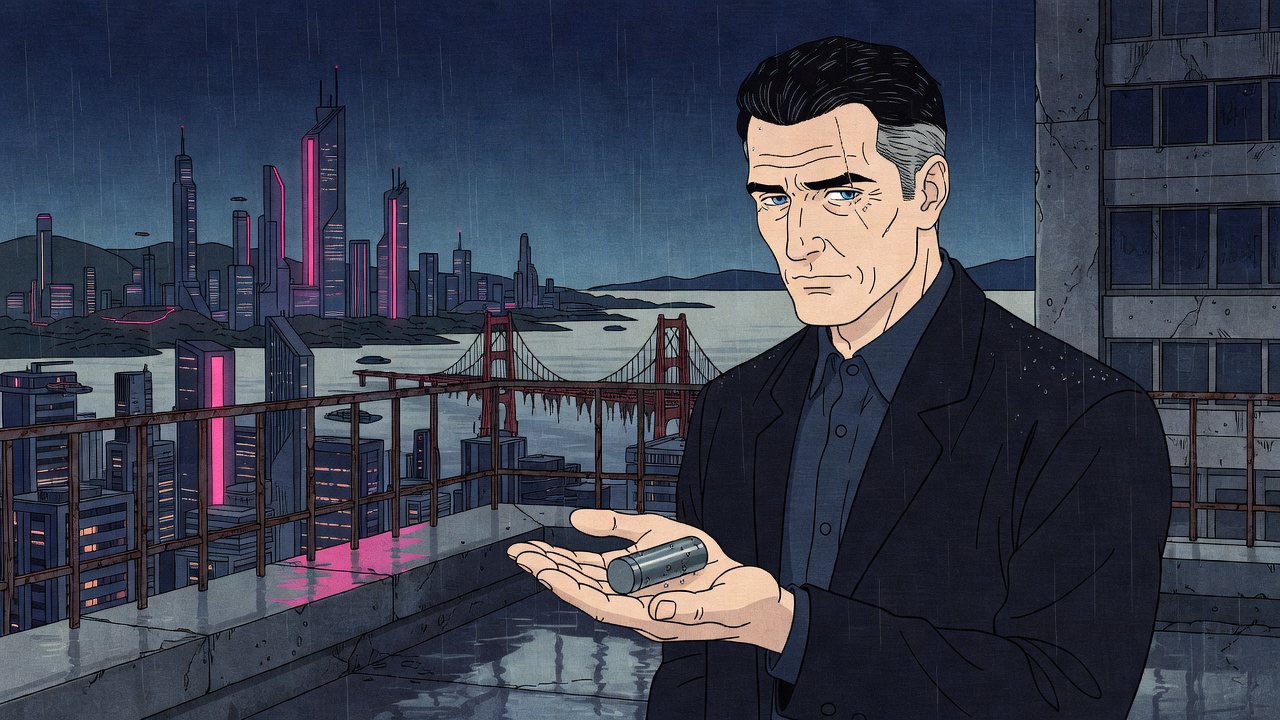
Richard K. Morgan · 2002–2005
Altered Carbon
The Takeshi Kovacs novels: three books, one mind, and every body it is poured into.
Richard K. Morgan’s first novel, Altered Carbon, came out from Gollancz in London in February 2002 and from Del Rey in the United States in March 2003, and its American paperback won the Philip K. Dick Award. Two more followed: Broken Angels in 2003 and Woken Furies in 2005. All three are told in the first person by the same man, Takeshi Kovacs, a former Envoy — a soldier conditioned to wake in any body on any world and go straight to work — and each is a different kind of book: a hard-boiled murder mystery on Earth, a war novel and treasure hunt on a colony world, and a revolution on the planet where Kovacs was born.
This is an unofficial reader’s companion to all three: each book summarized by its own parts and walked in painted frames, a page on the Protectorate and its hardware, and notes on Netflix’s two seasons, the anime film Resleeved, and every other attempt to bring the books to the screen. It spoils everything, the last page of Woken Furies included.
Stacks and Sleeves
Some centuries from now, humanity has spread across a few dozen worlds, governed from Earth by the United Nations Protectorate, and every person carries a cortical stack: a small implant at the top of the spine that holds the whole mind as data. The body around it is a sleeve. Sleeves die; stacks usually don’t. Load one into a new body and the person walks out again, if somebody pays. The rich — the Meths, after Methuselah — live for centuries in clones of themselves, some copied to remote storage so often that even a bullet costs them only a couple of days. Convicts lose their bodies and wait on a shelf as stacks while the bodies are rented out. A mind can run in virtual with no body at all, and it crosses between the stars by needlecast, sent as data and sleeved at the far end, because ships are slow. Destroy the stack, with no copy anywhere, and that is real death.
Morgan has said the idea began with an argument with a Buddhist about karma: why should anyone pay for a previous life he cannot remember? The books never let the technology feel clean. A sleeve comes with its last owner’s habits and enemies; a mind poured into a stranger’s flesh can feel itself fragment in a mirror; and in a release hall in Bay City, a family waits for a resleeved father who walks straight past them in his new face.
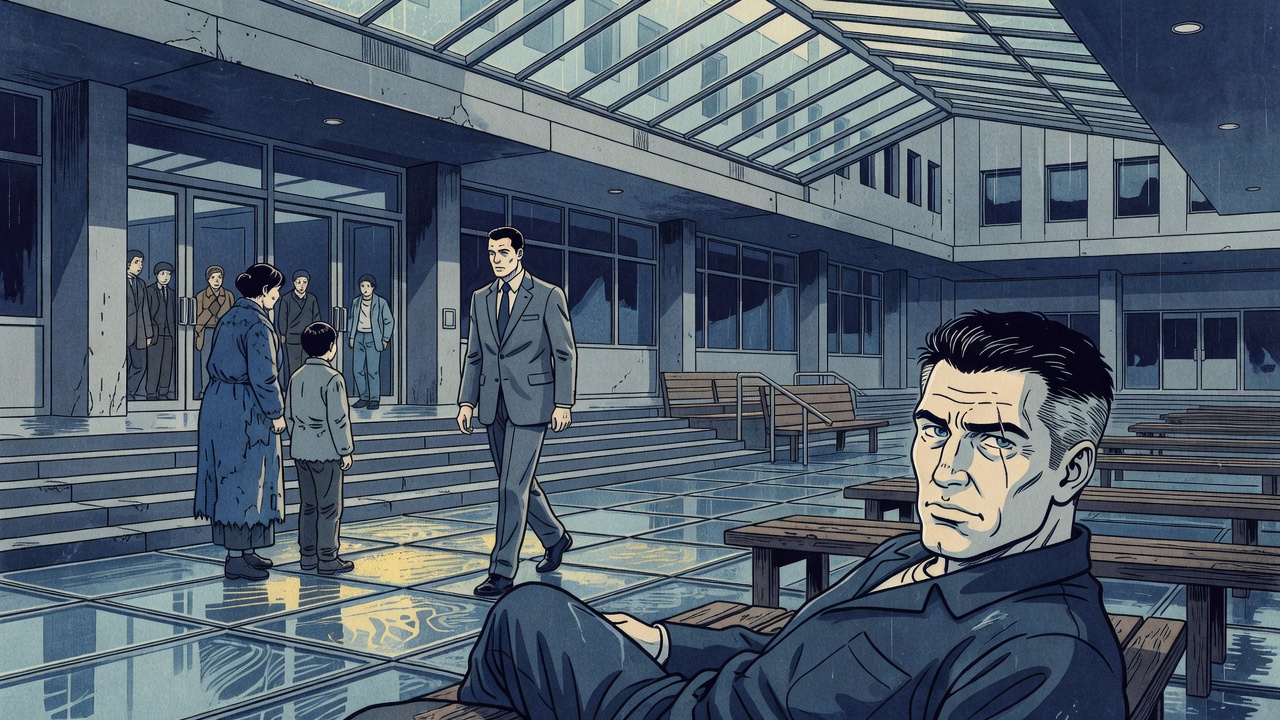
Takeshi Kovacs
Kovacs comes from Newpest, on Harlan’s World, a planet settled, as Morgan puts it, by a Japanese ruling class and an Eastern European labour force; hence the name. He grew up poor on the southern landmass of Kossuth, hating a father who beat his mother and sisters, and in Altered Carbon he remembers that father walking out of the family in a new body. He ran with gangs, was a Protectorate marine by eighteen, and then joined the Envoy Corps.
The Envoys are the Protectorate’s elite, needlecast wherever it needs them and conditioned to take in a new body and a new world at once: total recall, an intuition that builds a whole picture from scraps, fear shut down on demand. Kovacs’s trainer was Virginia Vidaura, whose maxims run in his head through all three books. His Envoy career ended at Innenin, a beachhead on the world of Sharya, where a virus attack on the soldiers’ stacks drove them mad and his friend Jimmy de Soto clawed out his own eye. Kovacs resigned. Ex-Envoys are barred from political or corporate authority, and most become mercenaries or criminals; he has been both, with long spells in storage between.
Morgan sums him up without sentiment — “He is not a moral man” — but highly intelligent, capable of great loyalty, and unsure how human he still is. The critic Paul Di Filippo put it another way: “Takeshi Kovacs has to be the worst friend you can have.” Each book jumps about thirty years, but Kovacs, who spends decades on the shelf, ages far less than the calendar. And he wears a different body in every book.
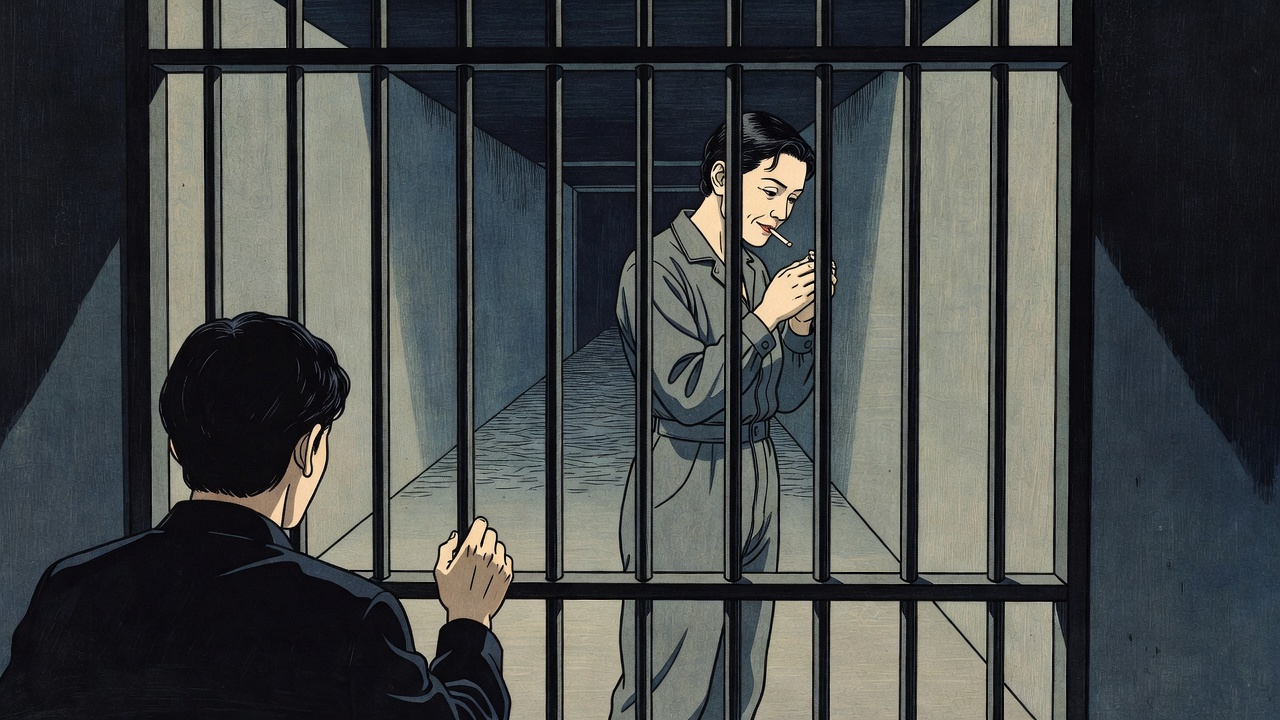
I · Altered Carbon
The first book opens with Kovacs and his partner in crime, Sarah Sachilowska, cut down in a raid in Millsport, on Harlan’s World. He wakes a hundred and eighty light-years away, in Bay City, the old San Francisco, in the body of Elias Ryker, a policeman in storage, leased for up to six weeks to Laurens Bancroft, a Meth more than three centuries old. Bancroft has been shot dead at home. The police call it suicide; his backup restored him minus two days; he wants Kovacs to find his killer.
What follows is a detective story in twenty-fifth-century clothes — one reviewer read it as The Big Sleep with stacks — with Kristin Ortega, the police lieutenant who was Ryker’s lover; Miriam Bancroft, three centuries old in a young woman’s body; an AI hotel called the Hendrix; the crime lord Reileen Kawahara; and Head in the Clouds, a brothel in an airship over the bay. The key is a law before the U.N., Resolution 653, which would let a murdered Catholic, who refuses resleeving, be brought back to testify. Bancroft, drugged on his wife’s orders and steered by Kawahara, killed a Catholic girl aboard the airship, then shot himself to keep the memory out of his backup. Kovacs double-sleeves to reach Kawahara and takes her with him in a fall from the airship; Miriam walks free with the only evidence, and Kovacs is needlecast home.
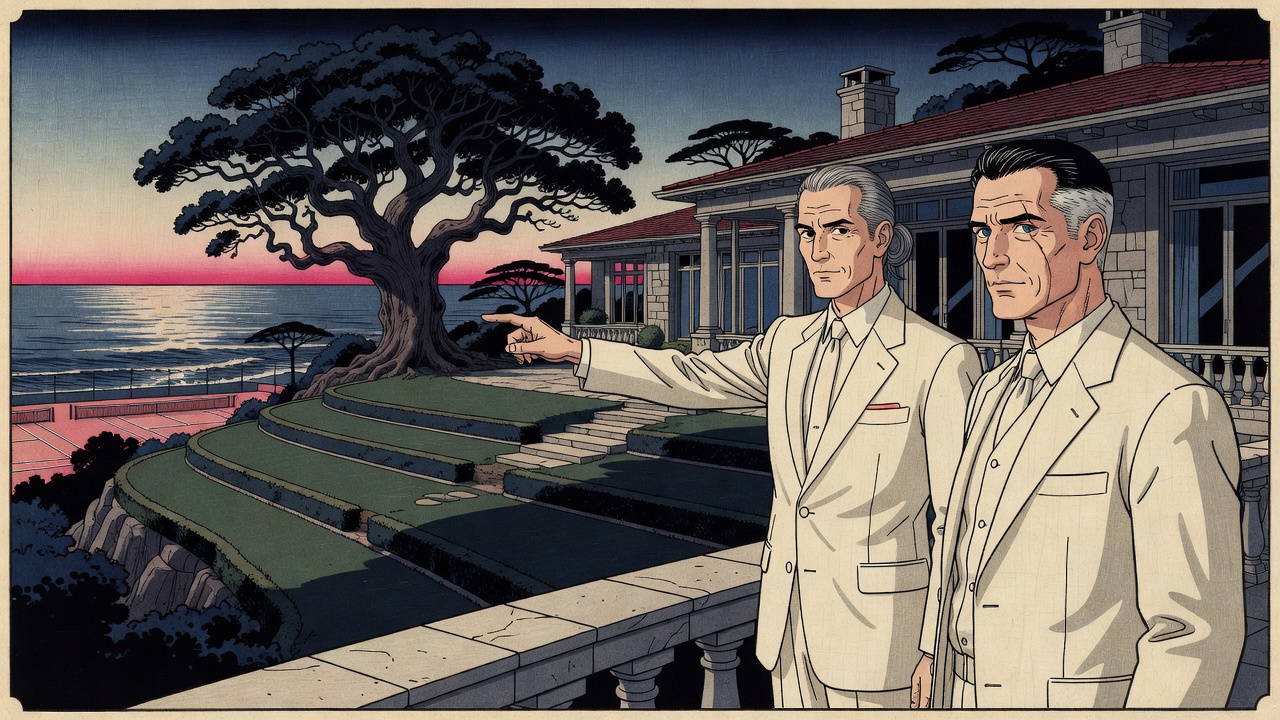
II · Broken Angels
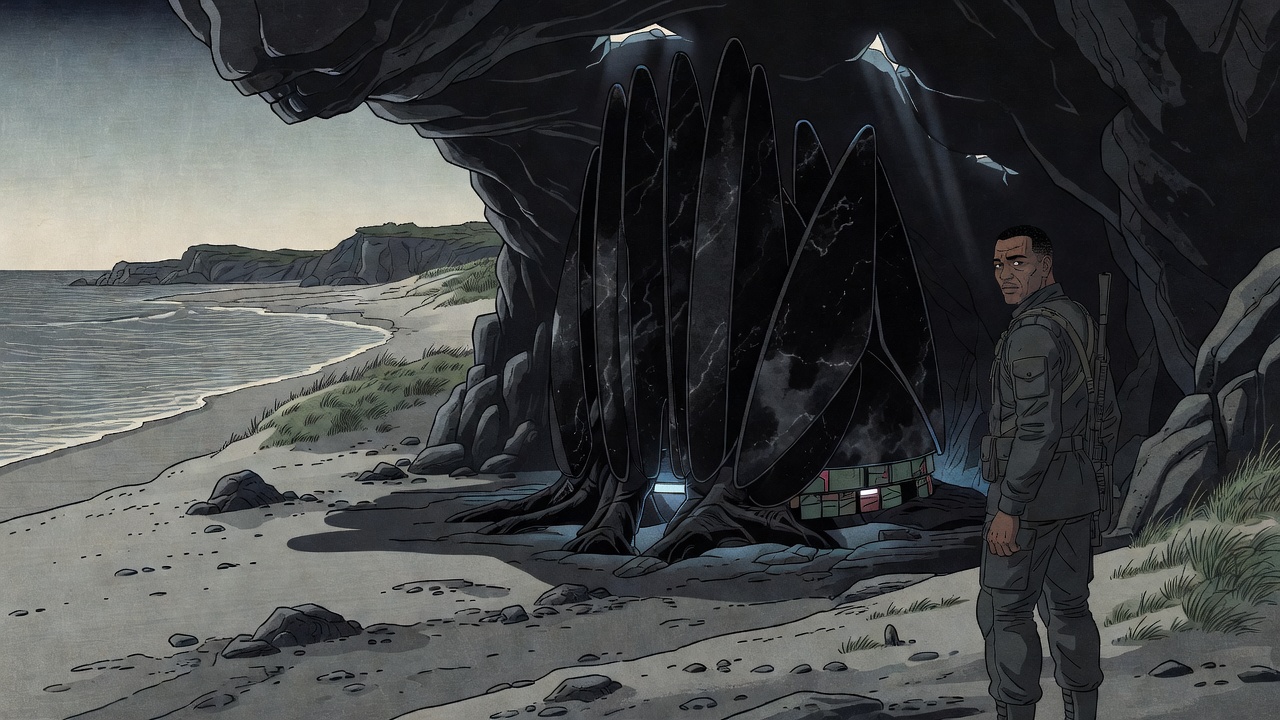
About thirty years later Kovacs is a lieutenant in Carrera’s Wedge, a mercenary force fighting for the Cartel government of Sanction IV against Joshua Kemp’s revolution, and he wears the Wedge’s Afro-Caribbean combat sleeve. A wounded pilot, Jan Schneider, tells him that archaeologues on the Dangrek coast found a Martian gate with a Martian starship beyond it. Kovacs springs the dig’s site regulator, Tanya Wardani, from an internment camp, sells the find to Matthias Hand of the Mandrake Corporation, and picks a team from the stacks of the war dead, bought in bulk at the Soul Market, all seven decanted into rad-resistant Maori combat sleeves. To clear the coast, Hand leaks the intelligence that gets the nearby city of Sauberville nuked, and its fallout slowly poisons the expedition.
Then the expedition comes apart. Nanobes kill two of the team on the beach in the attack that ends with the gate opening, onto deep space and a derelict Martian warship; a saboteur and a traitor work among the rest; the grief of the ship’s long-dead crew floods their minds; and the Wedge comes through the gate and hauls the survivors back. Kovacs breaks free, follows Carrera through the gate and kills him aboard the Martian ship, learns that Wardani left her first team to die rather than let them use the ship as a weapon, and sets out on the long voyage to Latimer, admitting at last that he came to Sanction IV for the Quellists. It is Morgan’s war novel, angrier and bleaker than the first — he acknowledges a debt to John Pilger — and the one book Netflix never adapted, though its second season borrowed names from it.
III · Woken Furies
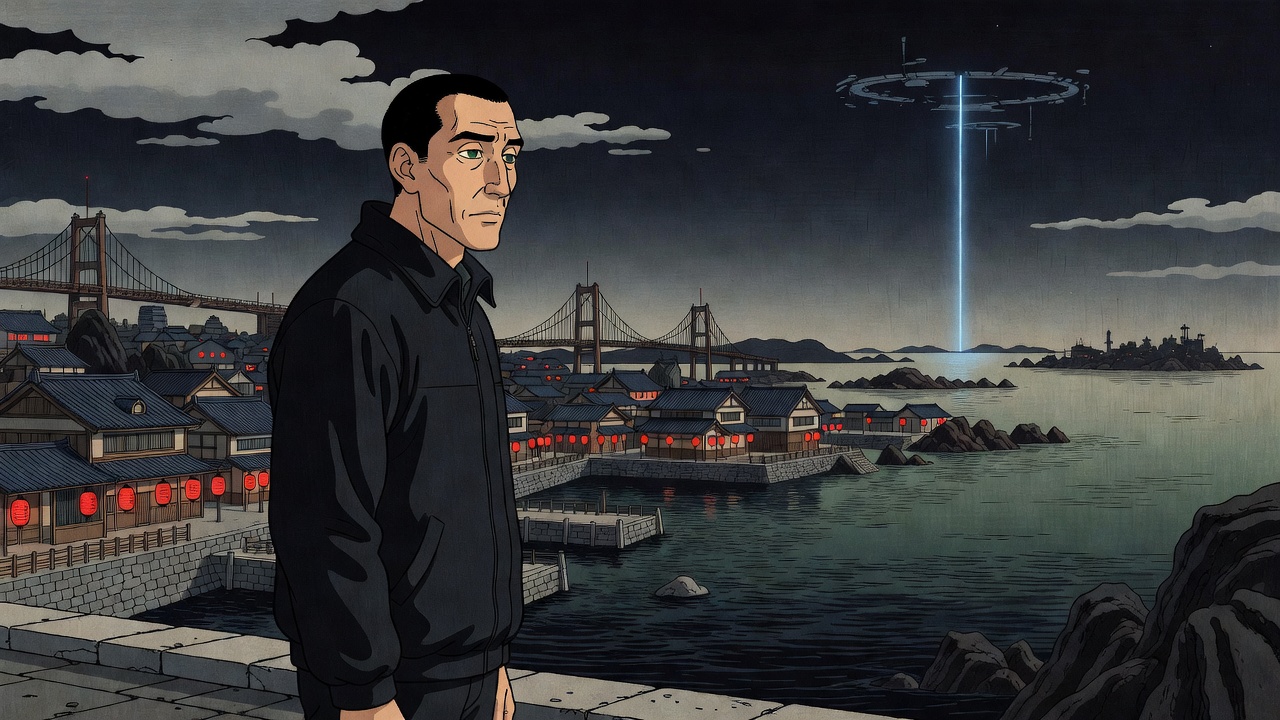
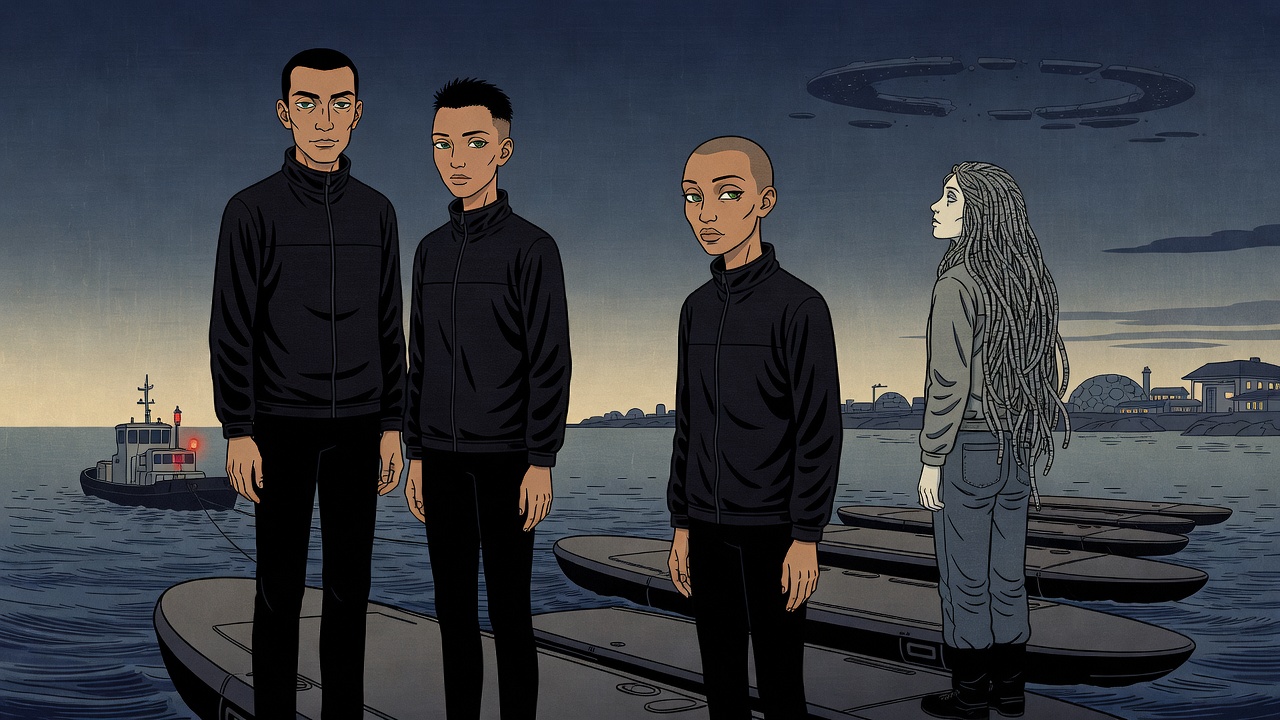
About thirty years on again, Woken Furies brings Kovacs home. Harlan’s World is mostly ocean, with three moons and archipelagos Morgan calls drowned mountain ranges, and overhead the orbital platforms the Martians left still burn anything that flies too high, so nobody flies there if they can help it. Kovacs is two years into a private war on the Knights of the New Revelation, a fundamentalist order, cutting out their priests’ stacks and refusing to say why. In a bar in Tekitomura he falls in with Sylvie Oshima, command head of a crew clearing old war machines out of New Hokkaido. Something in her head believes it is Quellcrist Falconer, the revolutionary dead for centuries whose words have opened chapters since the first book. Meanwhile the ruling Harlan family wake a copy of Kovacs from his Envoy days, younger and contemptuous, and set it hunting him.
The book runs from a war in the ruins of New Hokkaido, through a raid on the Harlan fortress of Rila Crags under a storm of angelfire, to a revolution that may be only beginning. Virginia Vidaura, the trainer in Kovacs’s head, turns up in person, a surfer now; the reason for the vendetta turns out to be Sarah; and the woman in Sylvie’s head is Quell after all, copied by the orbitals when they burned her jetcopter. The younger Kovacs dies — Kovacs spares him, and Jadwiga, one of Sylvie’s crew, does not — and the book ends with Sylvie and Quell learning to talk to the orbitals. It is the longest of the three and, two decades on, the last.
Three Books, One Life
“The three Kovacs books are stand-alones, at least in theory,” Morgan said in 2005, but they follow a rough chronology, and each pays off the one before. Four threads run through them.
The first is the Envoy Corps. Vidaura’s lessons are in Kovacs’s head from the first chapter of Altered Carbon, where he remembers her going into storage for eighty years to a century, and the ghost of Innenin a few chapters later; by Woken Furies she is out, in a sleeve at least ten years younger, and still calls him kid.
The second is Quellcrist Falconer. In the first book she is a quoted author, and Chapter Fifteen takes her line for its motto:
“The personal, as everyone’s so fucking fond of saying, is political.”
Broken Angels opens every part with her and ends with Kovacs owing the Quellists a report. Woken Furies brings her back.
The third is the Martians, a vanished winged race whose star charts, dug up on Mars, led humanity to its three dozen habitable worlds. The first book keeps them to relics, a songspire in a rich man’s hall; the second puts Kovacs aboard one of their warships; the third sets him under their orbitals and ends with someone learning to talk to them.
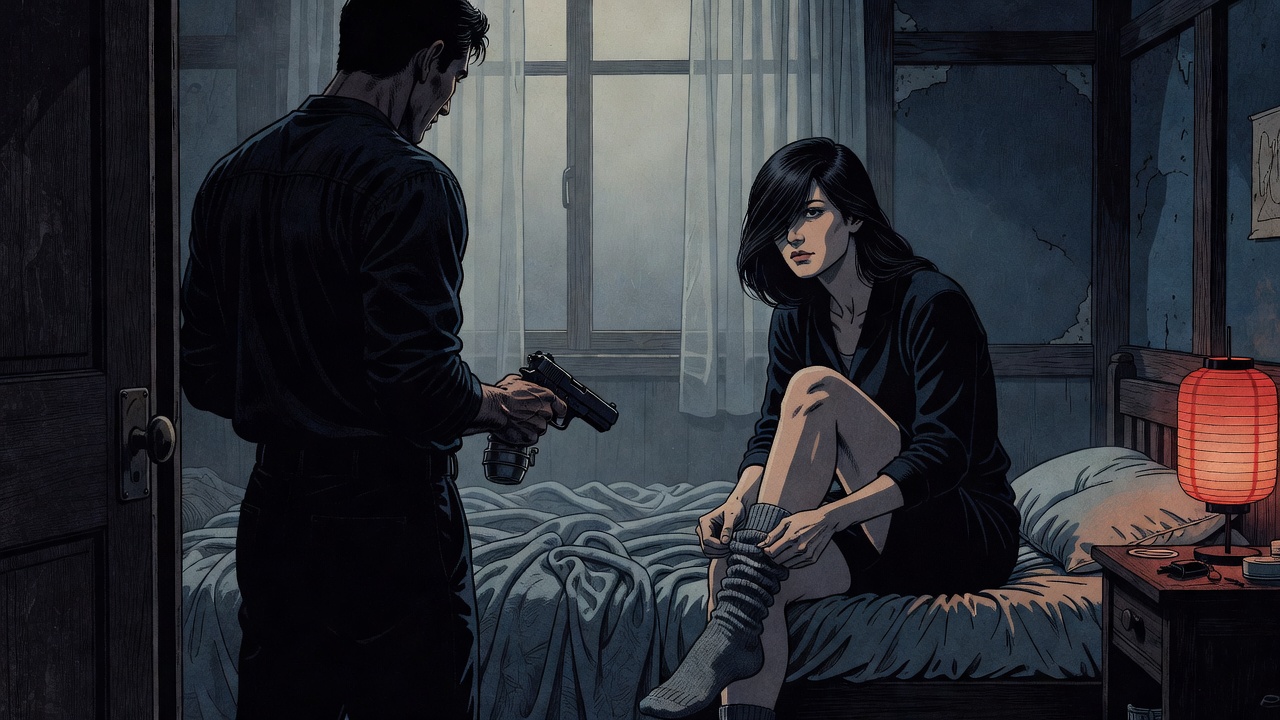
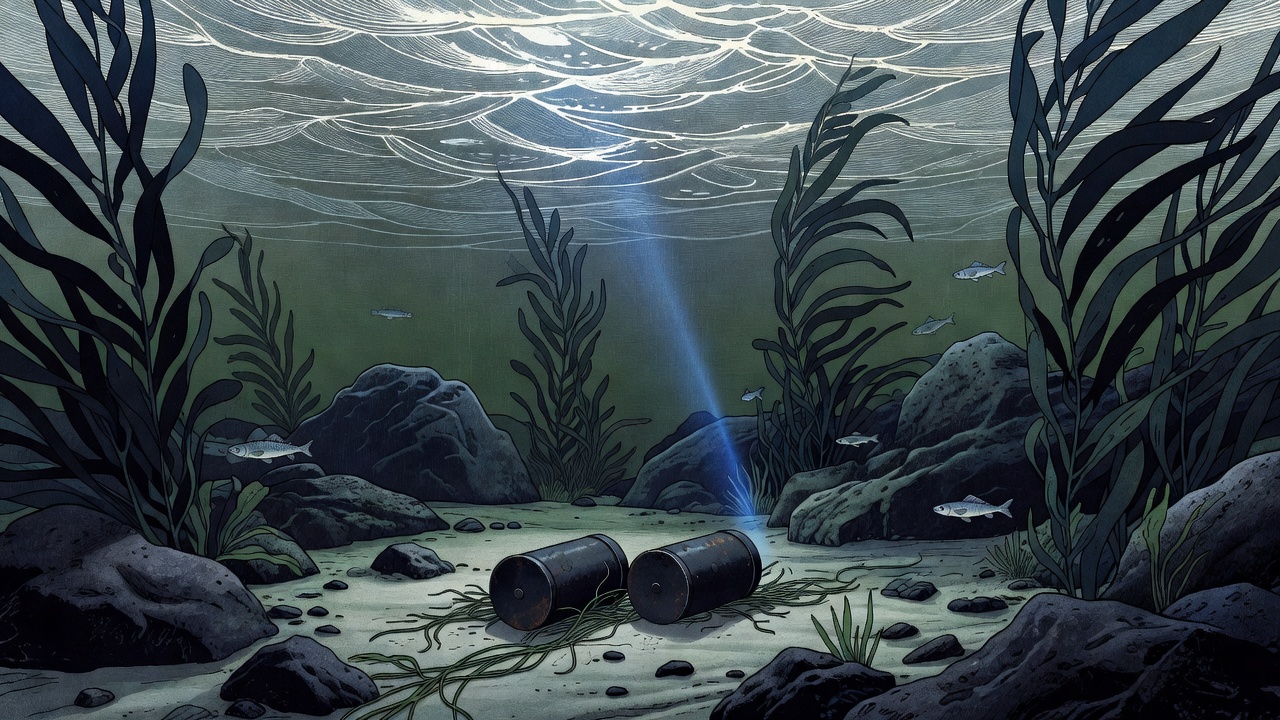
The fourth is Sarah. The woman beside him on the series’ first page is the reason for the killing in its last book: out of storage and happy for a while, she was hunted down by the New Revelation, and her stack and her daughter’s were cut out and dropped in the sea. The final lines hope the orbitals, which destroy and record at once, might one day find a pair of weed-grown stacks on the sea bed, theirs by every implication.
Morgan has not written a fourth novel. In 2005 he said he would rather quit while he was ahead; in 2020 he said he had stopped so the series would not “feel tired”, not because Kovacs had nothing left to do. As of October 2026, no new Kovacs novel has been announced.
On Screen
Warner Bros. optioned Altered Carbon for the producer Joel Silver in 2002 and never made it; around February 2012 the rights passed to Laeta Kalogridis’s Mythology Entertainment, and her Netflix series ran two seasons. Season 1 (2 February 2018, ten episodes, Joel Kinnaman as Kovacs in Ryker’s sleeve) adapts the first novel; season 2 (27 February 2020, eight episodes, Anthony Mackie) takes Kovacs home to Harlan’s World on the spine of Woken Furies. Netflix decided that April against a third, and the news broke in August. The anime film Resleeved (19 March 2020) is an original story set on the planet Latimer.
Where to Start Here
The Protectorate comes next: stacks and sleeves, needlecast, the Envoys, the Martians and the three worlds. Then the books in order, Altered Carbon, Broken Angels and Woken Furies, each summarized by its own parts and walked in thirty-four to forty frames, with notes on what the screen took from it. After them come the two seasons, Resleeved, the books vs. the series and every adaptation, made and unmade. One thing to know about the pictures: Kovacs changes body in every book, so he changes face; the cast below says which body is which.
The cast
Takeshi Kovacs
Kristin Ortega
Laurens Bancroft
Miriam Bancroft
Reileen Kawahara
Virginia Vidaura
Jimmy de Soto
Sarah Sachilowska
Tanya Wardani
Jan Schneider
Matthias Hand
Isaac Carrera
Sylvie Oshima and Quellcrist Falconer
The other Kovacs
Jadwiga
Radul Segesvar
Aiura Harlan-Tsuruoka
Reading order
- Read them in publication order, which is also story order: Altered Carbon, Broken Angels, Woken Furies. Morgan calls them stand-alones in theory, but says you get a little more out of each if you read them in order, and the later books lean hard on the earlier ones.
- I · Altered Carbon — Gollancz hardback, 28 February 2002; Del Rey trade paperback, 4 March 2003, the edition that won the Philip K. Dick Award. A Prologue, five parts and an Epilogue.
- II · Broken Angels — Gollancz, 20 March 2003; Del Rey trade paperback, 2 March 2004. Five parts, each opened by a Quellcrist Falconer epigraph, and a short epilogue.
- III · Woken Furies — Gollancz, 17 March 2005; Del Rey hardback, September 2005. A Prologue, four parts and an Epilogue; the longest of the three.
- Later editions: Del Rey mass-market paperbacks (2006–08); Netflix tie-in reissues of Altered Carbon from Gollancz and Del Rey in February 2018; and a Subterranean Press limited edition of Woken Furies (2020), illustrated in colour, now out of print.
- On audio: Todd McLaren reads Altered Carbon and Broken Angels (Tantor Media, 2004–05); William Dufris reads Woken Furies (Tantor, 2006).
- The graphic novels (Dynamite): Altered Carbon: Download Blues (2019), written by Morgan with Rik Hoskin and drawn by Ferran Sellares, and Altered Carbon: One Life, One Death (2022, after more than a year of delays), Scott Bryan Wilson’s story with Morgan, drawn by Max Fuchs. Both are new cases for Kovacs, not adaptations, and can be read at any point.
- On screen: season 1 (2018) adapts Altered Carbon; season 2 (2020) borrows the frame of Woken Furies; Resleeved (2020) is an original story; Broken Angels has never been adapted.
Notes
- Names. The book and world pages use the novels’ spellings: Sachilowska, Victor Elliott (the show’s Vernon), Irene (Ava), the Hendrix (the show’s Raven, run by an AI Poe), the Martians (the show’s Elders). The season and film pages use the show’s names.
- The stack in the pictures. The novels never dwell on what a stack looks like, and Netflix made it a metal disc at the back of the neck. The frames here paint it as a small dark cylinder, held in a palm or lying in a tray.
- Dates and ages. Publishers Weekly’s review put Altered Carbon in the twenty-fifth century, and each sequel is set about thirty years after the one before. Kovacs, stored for decades between jobs, has lived far fewer years than the calendar shows; the birth year some sources give him comes from a newspaper article, not the novels, and is left out here.
- Awards. Altered Carbon won the Philip K. Dick Award (given in 2004), placed third in the Locus poll for best first novel and won Italy’s Premio Italia in 2005. Morgan’s John W. Campbell Memorial Award (Market Forces) and Arthur C. Clarke Award (Black Man) were for novels outside the series.